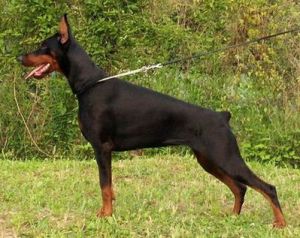
Dogs sometimes suffer from behaviors such as tail chasing, flank or blanket sucking and other repetetive behaviors that can be harmful and that are diagnosed as Canine Compulsive Disorder and considered an analog to OCD in humans. The extraordinary phenotypic diversity of dog breeds has been sculpted by a unique population history accompanied by selection for novel and desirable traits. These wanted traits may also lead to an accumulation of a disorder within one breed and may be of special interest when studying the genetics of certain traits.
Dodman and collegues studied 92 doberman pinchers (pet dogs) that had flank or blanket sucking and controls with a genome wide association study (GWAS) and found a new canidate gene; CDH2. CDH2 is widely expressed,
mediating synaptic activity-regulated neuronal adhesion. Dogs showing multiple compulsive behaviors had a higher frequency of the risk allele than dogs with a less severe phenotype. Kerstin Lindblad-Toh and others at Broad Institute and Uppsala University are continuing to investigate this and other candidate genes. A recent Finnish study by Tiira et al of tail chasers but in 3 other dog breeds than Dobermans failed to find an association with CDH2.
For those interested in a more detailed review of animal models in OCD we recommend a review by Albeleda and Joel in Neuroscience 2012 (see below for full reference).
Dodman NH, Karlsson EK, Moon-Fanelli A, Galdzicka M, Perloski M, Shuster L, Lindblad-Toh K, Ginns EI. A canine chromosome 7 locus confers compulsive disorder susceptibility. Mol Psychiatry. 2010 Jan;15(1):8-10.
Tiira K, Hakosalo O, Kareinen L, Thomas A, Hielm-Björkman A, et al. (2012) Environmental Effects on Compulsive Tail Chasing in Dogs. PLoS ONE 7(7):e41684. doi:10.1371/journal.pone.0041684
Albelda N, Joel D. Current animal models of obsessive compulsive disorder: an update. Neuroscience. 2012 Jun 1;211:83-106.





 Rücklab - Psychiatry research at Karolinska Institutet