
Our lab has a new publication in BMJ Open where we look at two-year outcomes after internet-delivered CBT for body dysmorphic disorder (BDD-NET). The results were promising: we saw further improvements in BDD symptoms and 56% of participants no longer had BDD at the two-year follow-up.

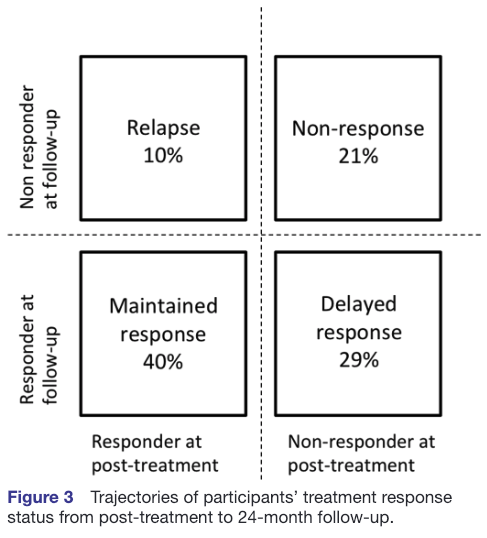
A notable and perhaps surprising finding is that 29% of participants had a delayed response: they were not classified as treatment responders at post-treatment but were treatment responders at follow-up. We discuss this in the publication: “Perhaps participants continued to employ the techniques that they had acquired during the acute treatment phase in their daily lives, in part explaining the additional improvements seen in BDD symptoms during the follow-up.”
We conclude that BDD-NET is an effective treatment and that gains are sustained in the long term. However, since the follow-up was uncontrolled we cannot say that BDD-NET caused these improvements, and we also note that all participants were self-referred and motivated to do the treatment. The results are nonetheless encouraging and we will continue to evaluate BDD-NET as a treatment in different contexts.
Full citation: Enander, J., Ljótsson, B., Anderhell, L., Runeborg, M., Flygare, O., Cottman, O., … Rück, C. (2019). Long-term outcome of therapist-guided internet-based cognitive behavioural therapy for body dysmorphic disorder (BDD-NET): a naturalistic 2-year follow-up after a randomised controlled trial. BMJ Open, 9(1), e024307. https://doi.org/10.1136/bmjopen-2018-024307


 Rücklab - Psychiatry research at Karolinska Institutet