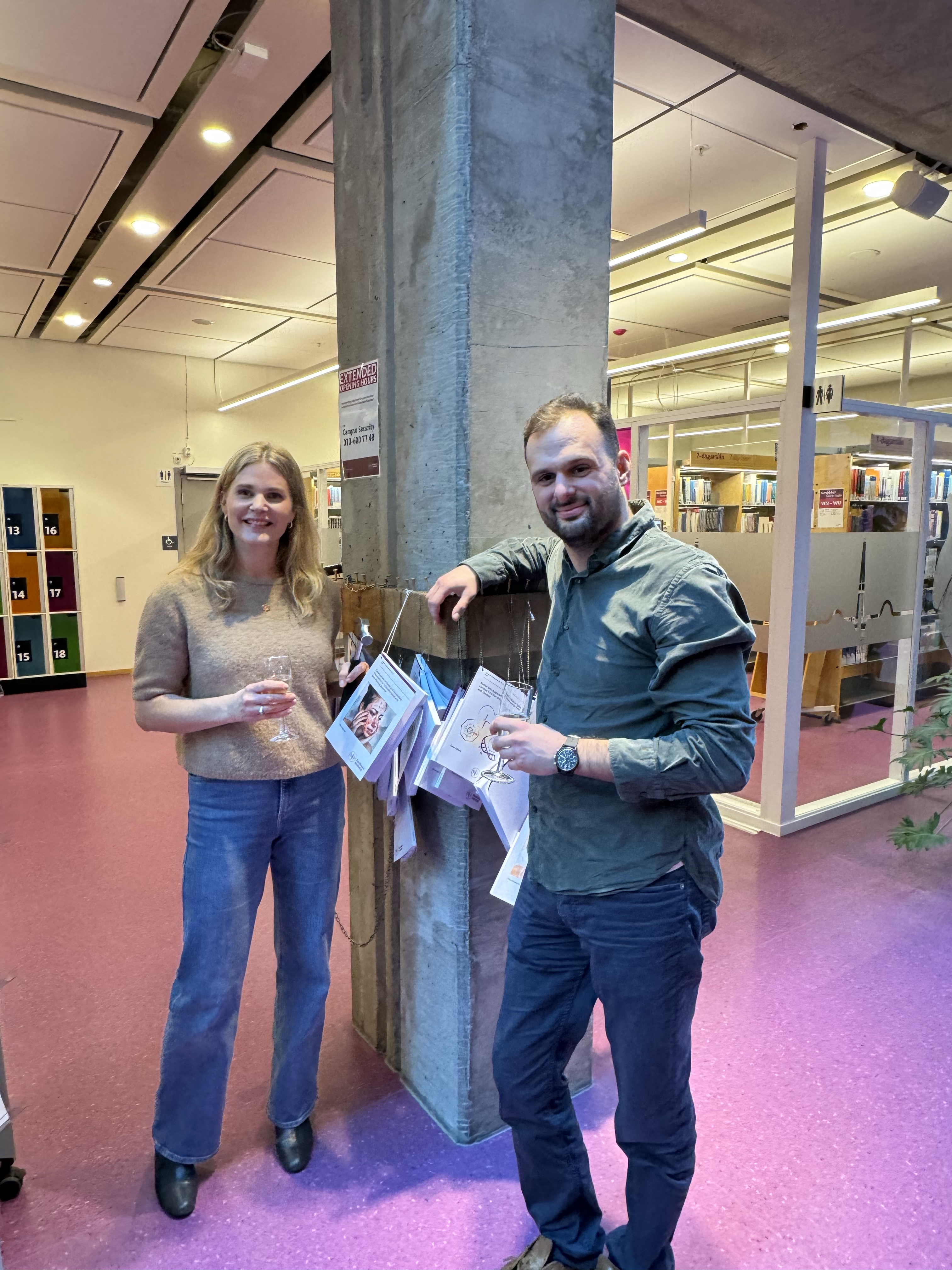
Today, Mia Asplund nailed her thesis at the KI library in Flemingsberg. Also present, of course, was supervisor Volen Ivanov. Well hammered and congratulations!

Rücklab – Psychiatry research at Karolinska Institutet
Research on OCD and related disorders, precision psychiatry, psychiatric genetics, suicide prevention, stress and PTSD

Today, Mia Asplund nailed her thesis at the KI library in Flemingsberg. Also present, of course, was supervisor Volen Ivanov. Well hammered and congratulations!

In this new summer course given by Karolinska Institutet (KI), we explore how artificial intelligence (AI) is researched and integrated into mental healthcare, particular psychiatry, to improve tailored patient care. Throughout the course we also debate ethical implications of this ongoing paradigm shift and its consequences for mental healthcare.
The course provides a comprehensive interdisciplinary perspective on both opportunities and challenges of AI with a focus on clinical psychology and psychiatry. Focus areas include conversational agents, suicide prediction, and applied machine learning for the purpose of improved tailored treatment, monitoring, and care. These topics are studied from a general perspective regarding strengths and limitations of humans versus machines. Lectures are supported by collaborative seminars on cutting-edge findings. Interactive workshops provide possibilities for both theoretical development and hands-on use and construction of AI-tools.
The course will take place from the 3rd until the 17th of June at Flemingsberg (full-time study).
Learn more about the course here.
You can apply to the course now!

Research team leader Christian Rück’s book is now out! And it has already received great reviews, including in Svenska Dagbladet and Göteborgsposten.
The theme of the book itself seems to make an impression on the reviewers. Does a book about suicide have a place on the bookshelf?
Furthermore, the book raises questions among the critics:
Which suicides do we accept in our culture? Is a zero vision for suicide achievable? Is a person who commits suicide due to e.g. mental illness “wrong” in their claim? What are the limits of human autonomy?
“Boken är tunn och välskriven. Ändå tar det tid att läsa. Rücks raka prosa och de överlevande han intervjuar berör och lockar till eftertanke – med jämna mellanrum måste jag helt enkelt lägga boken ifrån mig och bara låta orden smälta.”
– Celia Svedhem, Göteborgsposten
Further, in Dagens Nyheter, Lisa Magnusson discusses the deaths at the Golden Gate Bridge and possible problems with the zero vision for suicide based on the book.



Let’s hope the discussion continues to thrive!
 Rücklab - Psychiatry research at Karolinska Institutet