
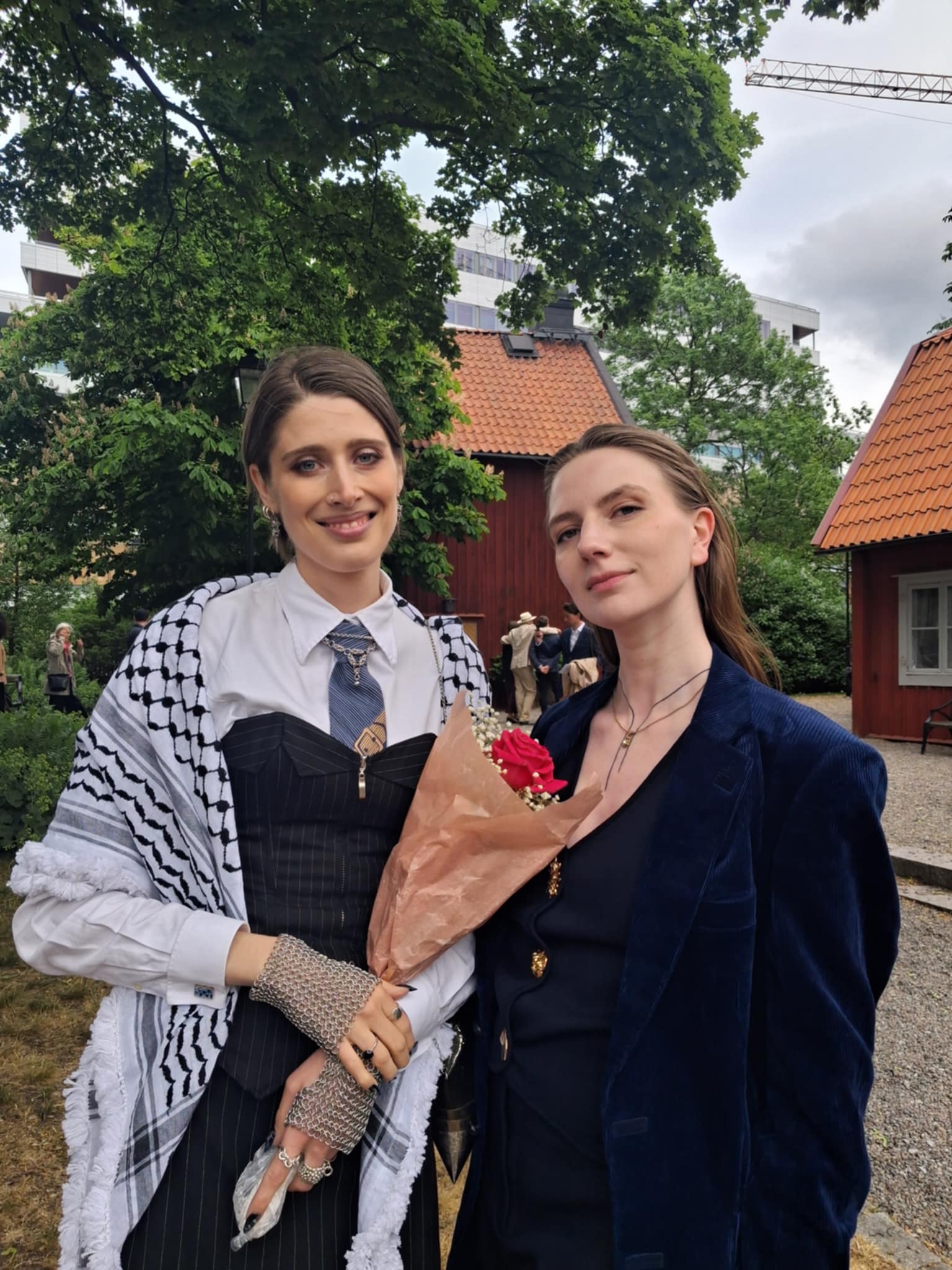
At the end of the spring semester, psychology students Victoria Ruud and Hanna Rolfsdotter defended their Master’s thesis—a project on therapists’ experience with intense Prolonged Exposure therapy as a treatment method for PTSD—carried out under the supervision of Maria Bragesjö and Sim Jamil. We recently asked them to share insights from their work and were excited to learn more about their topic as well as their methodology.
Their findings cover fascinating insights into the efficiency of this kind of therapy, as characterized by fast results and higher levels of motivation among patients as well as therapists. However, for such positive effects to be reaped it is also of utmost importance that patients have a say in the choice of their treatment, that both patients and therapists believe in the method, and that therapists have a supportive team to share the burden of such intense trauma treatment with. What’s interesting is that these effects seem rather intertwined. As Hanna describes it:
“The pros and cons stem from the same origin: the intensity is rewarding due to the fast results, but it’s also the intensity that can end up being overwhelming or feel like a burden as the therapists have insight into many cases of trauma treatments simultaneously due to group sessions, guidance meetings, and daily check-ins with their team. It’s gratifying because you learn a lot about the diagnosis and the treatment, but it can also be burdensome since you find yourself in so many traumatic stories at the same time.”
As for their research approach, the two students used reflexive thematic analysis in order to investigate this matter. Such methodology requires a high level of thematic reasoning so as to avoid simple topic summaries, as well as extensive consideration and acknowledgement of the subjective qualities and approaches of the researchers when going into a project like this—something that differs from previously established notions of perceived objectivity in qualitative and quantitative research alike. Victoria talked about the importance of recognizing the subjective influence of the researcher, what form it takes, and how it interacts with the material at hand:
“We kept shared logbooks as well as separate reflexive diaries in order to give ourselves the space to reflect on the experiences we had and the work we did throughout this project. We discussed a lot with each other, and weren’t scared to challenge ideas and conclusions. We come from different backgrounds, have different personalities, and different strengths and opportunities for improvement. All of this was important to keep in mind and to remember when we carried out the analysis.”
As such, Hanna and Victoria have mapped highly important aspects to take into consideration when designing and implementing effective treatments for PTSD, while simultaneously demonstrating a great example of the reflexive thematic analysis approach. We congratulate them on work well done, and look forward to following them in the future! 🎉
 Rücklab - Psychiatry research at Karolinska Institutet