This week we found out that our application for funding to establish a new research center was approved. The Centre for Applied Psychiatric Research and Innovation (CAPRI) will be focusing on severe psychiatric conditions in high-intensity care settings, with the aim of furthering knowledge and creating better treatments for the most vulnerable patients. Main applicant for the centre is Christian Rück, who led the team to submit the application being granted 48 million sek by Forte. Congratulations, and thank you Forte! 🎉
Category: News
We are happy to announce that yet another article is coming out of the Rück Research Group! This time we have Christian Rück and John Wallert as co-authors for a paper titled “Genome-wide association analyses identify distinct genetic architectures for early-onset and late-onset depression” published in nature genetics. The article investigates how genetic architectures can be leveraged to improve treatment design for different expressions of depression. Congratulations Christian and John! 🎉
The article can be found here.
We are happy to welcome our new research assistants, Erik Melin and Penny Taka, to the team!
Erik has a background in economics and a Magister Degree (Civilekonomexamen) from Linnéuniversitetet in Växjö. He is currently studying at KI, the third term of the Study Programme in Psychology. He will be assisting team members and leaders in John Wallert’s team with different tasks relating to their various research projects.

Penny is in her third year of the five-year study Programme in Psychology at the Karolinska Institute and holds a BSc in Business and Economics from the Stockholm School of Economics. She has previous work experience from healthcare and business settings, and is now looking forward to supporting ongoing research projects as a research assistant!

A warm welcome to them both! 👏
More exciting research is coming out of the Rück Research Group! 🥳 Led by Leoni Grossman, PhD student with the group, the study Suicide after involuntary psychiatric care: a nationwide cohort study in Sweden investigates suicide risk indicators among different subgroups of patients receiving involuntary psychiatric care. You can read it in full in The Lancet Regional Health here!
The Rück Research Group had a new article come out in BMJ Mental Health this week! The study, titled Patterns of sex-specific and age-specific risk indicators of suicide: a population-nested case-control study and led by Fredrik Johansson, investigated risk indicators of suicide and how they relate to actual suicide numbers among groups with certain demographic characteristics. Read it here: https://mentalhealth.bmj.com/content/28/1/e301959
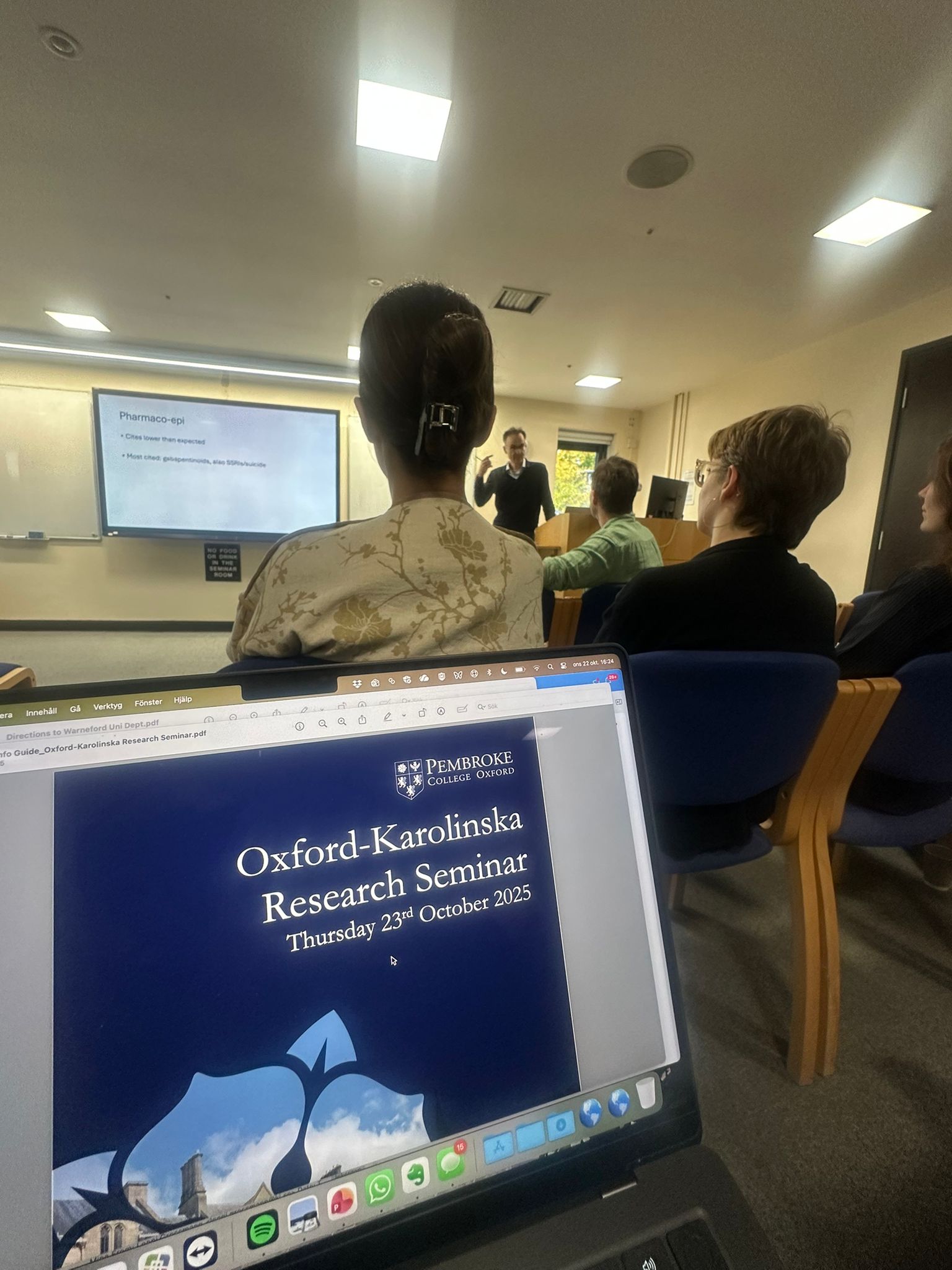
Last week, members of the Rück Research Group visited collaborators in Oxford. The purpose of the trip was to further existing partnerships with our British colleagues within a range of different projects—an endeavour that proved highly successful! 🏫



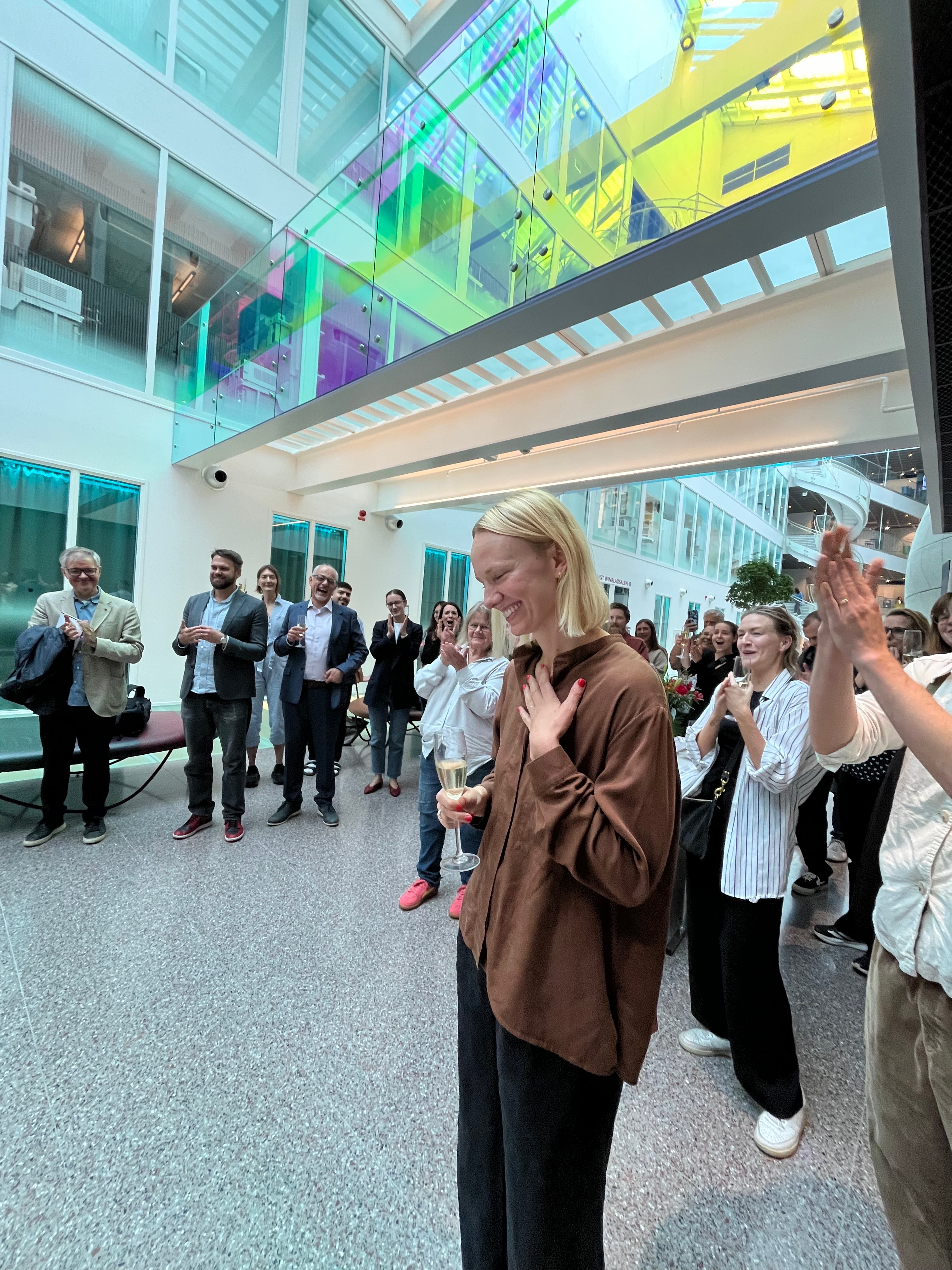
On Friday, our very own Julia Bäckman defended her dissertation, and of course passed with flying colors! Her thesis, titled Bridging Genes and Therapy: Insights into CBT Outcomes for OCD, anxiety and depression, explores when CBT is and is not effective with the aim of ensuring that as many individuals as possible can receive the treatment that fits them best. It can be found here.
Among the many spectators were the majority of Julia’s supervisors, Christian Rück (main supervisor), John Wallert, and David Mataix-Cols, as well as the examination board, consisting of Sandra Tamm and Ida Karlsson from the Karolinska Institute and Filip Arnberg from Uppsala University. Acting as the opponent was Evangelos Vassos from King’s College.
Congratulations, Julia, on a successful dissertation defence! We are incredibly proud of you and can’t wait to follow your continued journey! 🥳👏
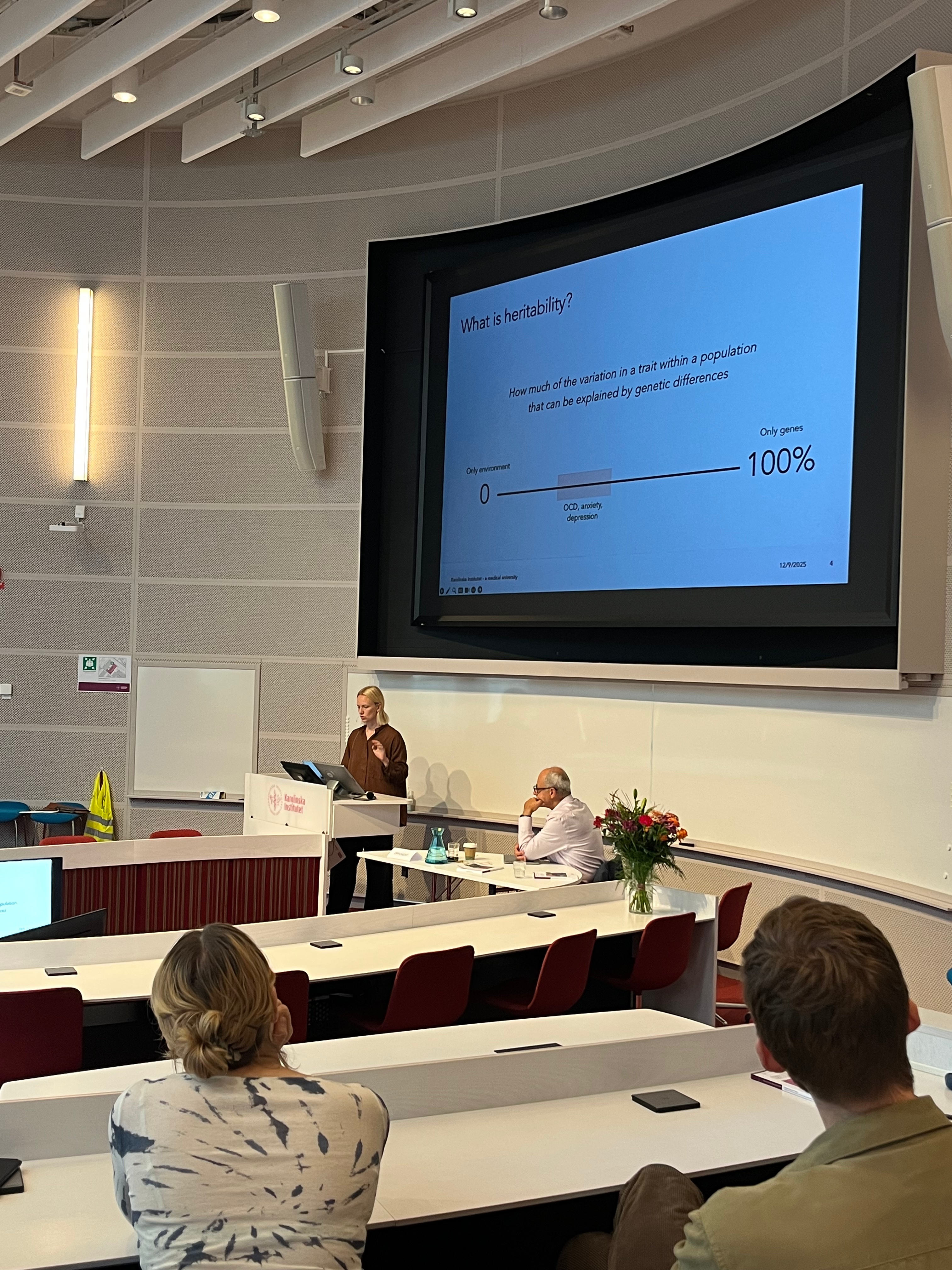

Last week, Julia nailed her dissertation Bridging Genes and Therapy: Insights into CBT Outcomes for OCD, anxiety and depression. We look forward to her disputation on September 12th and wish her good luck! 👏

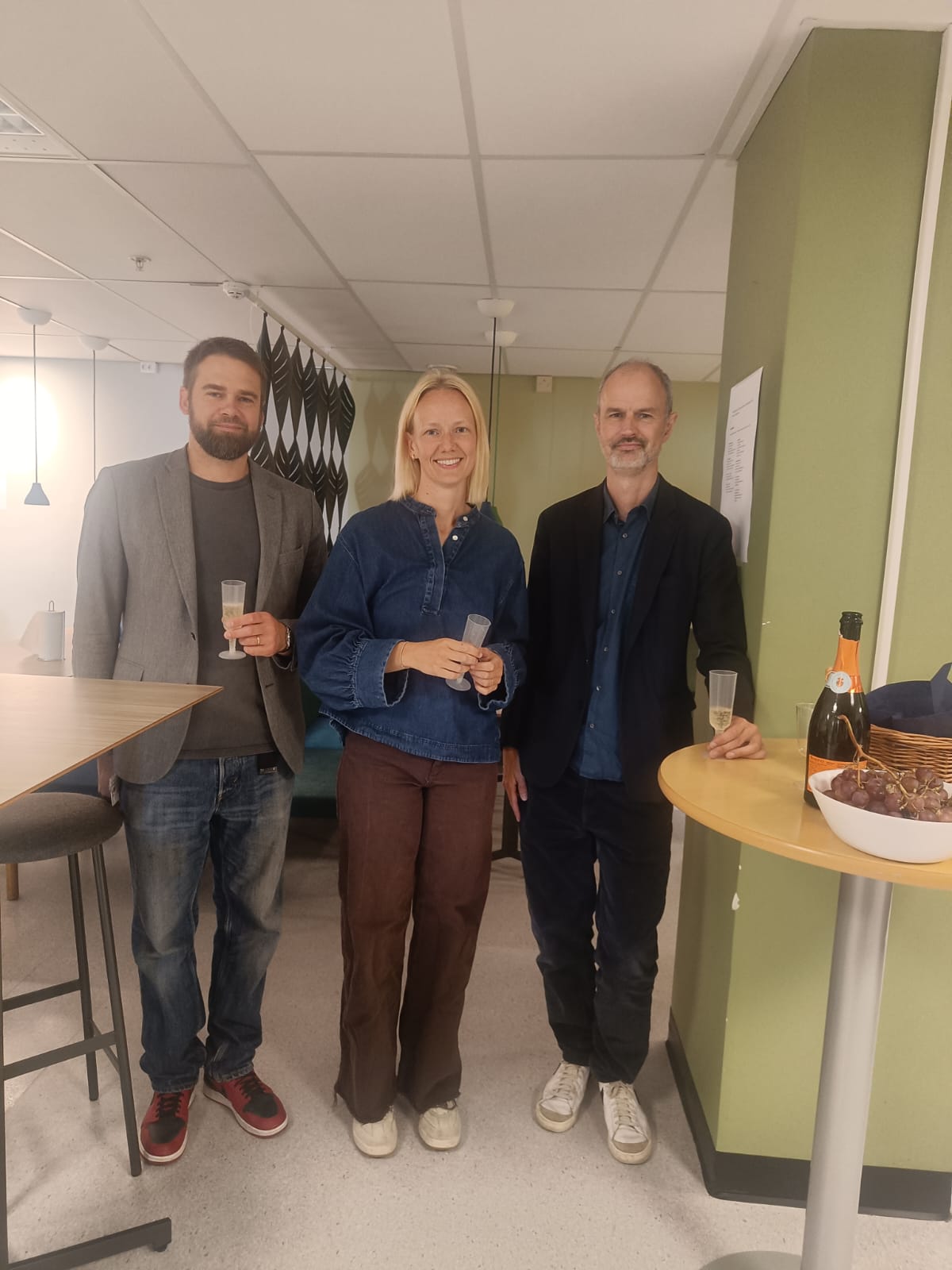

We are happy to introduce another exciting addition to the team! 🎉
Danny Majid is an MD and PhD student at Karolinska Institutet, currently completing his residency in psychiatry at Psykiatri Sydväst. His research focuses on emotion processing and regulation in individuals with intellectual disability (ID). The project uses eye-tracking and explores whether pain and generalized joint hypermobility are associated with behavioural dysregulation in ID. He will also evaluate whether dialectical behaviour therapy (DBT) can improve emotional regulation in this population. His main supervisor is Long-Long Chen.
We are excited to have Danny on board!

In addition to Hanna and Martin, we would like to welcome Filip Jonsson to the group!
Filip is a PhD student with a background in medical ethics research. He also works as a junior physician, holding an MD from Karolinska Institutet.
Filip’s research concerns ethical and legal questions regarding suicide risk assessments, with Docent Manne Sjöstrand as main supervisor.
We’re excited to have him on board! 🥳