The mental illness jar – A metaphor for how vulnerability to mental illness develops as an interaction between genetic and environmental factors, and the role of protective factors. 🥫
Research on OCD and related disorders, precision psychiatry, psychiatric genetics, suicide prevention, stress and PTSD

The mental illness jar – A metaphor for how vulnerability to mental illness develops as an interaction between genetic and environmental factors, and the role of protective factors. 🥫
Postdoc Maria Bragesjö is currently working on two novel treatment formats for PTSD: intensive trauma focused treatment and digital prolonged exposure. These treatment formats have the potential to be more effective, cost-effective and tolerable for patients than existing treatments, while increasing accessibility for those who need help.

We recommend watching the documentary Samlarna by Linnea Widén on SVT. The film portrays people suffering from hoarding disorder. And be sure to keep an eye out for our beautiful hoarding experts Volen Ivanov and Sofia Jägholm.
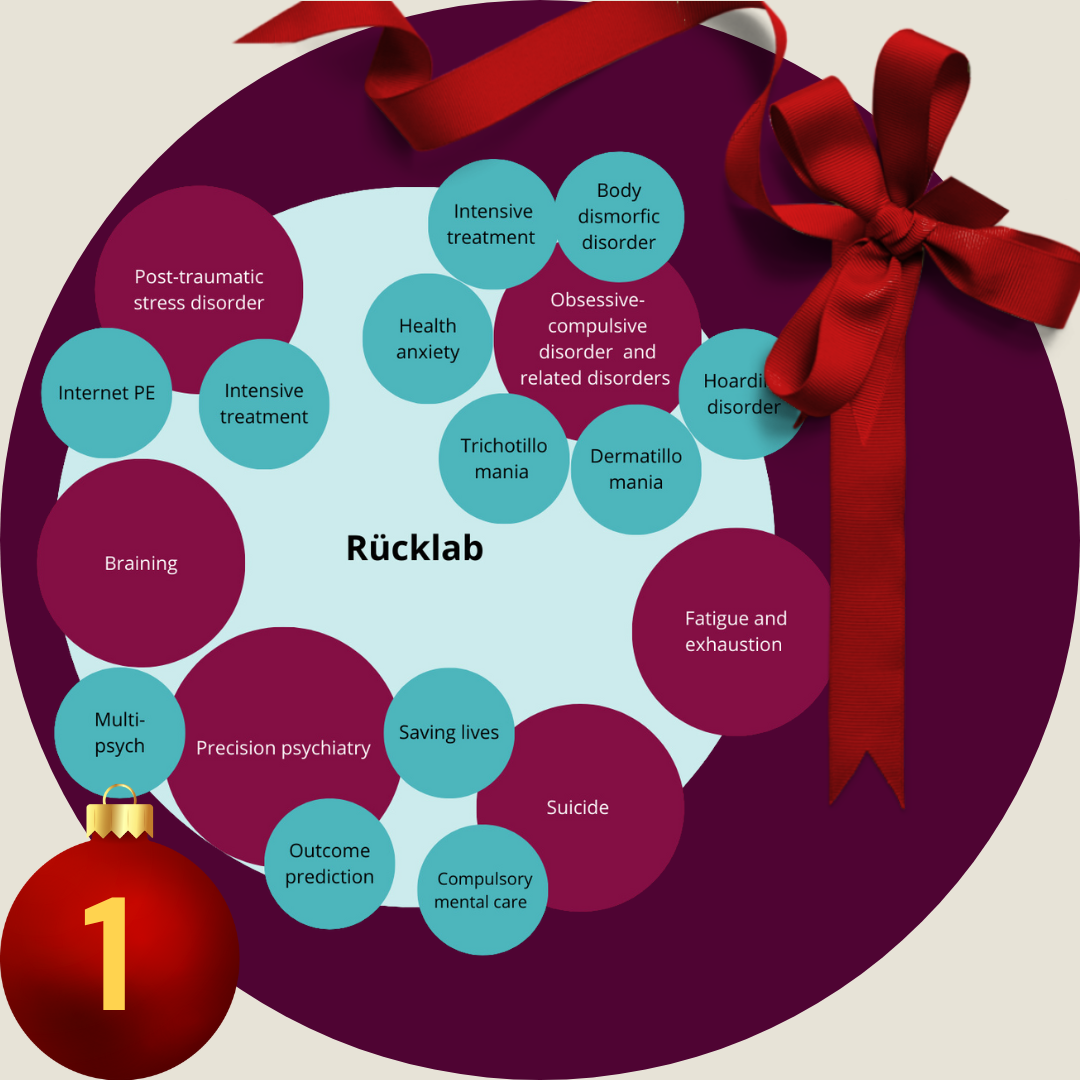
🎄✨ Countdown to Christmas! We’re happy to announce Rücklab’s 24-Day Christmas Calendar! Starting today, join us in a festive journey as we unveil a new post every day leading up to Christmas.
Let’s start by introducing ourselves. Rücklab works in a wide range of areas of psychiatric research: OCD, suicide, fatigue, PTSD and precision psychiatry.
Yesterday, Max made an outstanding appearance on TV4 Efter fem talking about obsessive-compulsive disorder and the Bergen study. The Bergen 4-day treatment compares an intensive treatment format of four consecutive days of combined group and individual therapy with gold-standard weekly treatment.

Recently, you may have come across our research in your daily podcast feed.
In Beslutspodden, Lina Martinsson – research team leader and operations manager at Psykiatri Sydväst – visits and talks about her career as a reserarcher/clinician/manager. Lina runs the Braining project – physical activity in a clinical setting, involving both patients and clinicians.
We also noticed that our Bergen 4 day treatment non-inferiority RCT for OCD was mentioned in the Daddy Issues podcast a while ago. Julia Lyskova talks about her experience of being a participant in the study’s intensive treatment study arm. She describes her OCD-related problems and the extent to which they have affected her daily life and well-being. “I have thought that I have killed everyone I love”, Lyskova says in the podcast, summarizing what it can feel like to live with the disorder. She also describes her ambivalence about participating and approaching what she is afraid of, how much willpower is required to attend the treatment and the experience of improvement.
Take the time to listen to these two podcasts that bridge research and reality.


Click here to read more about Braining.
Click here to read mor about the Bergen 4-day treatment and the randomized controlled trial.
In the latest episode of KI’s podcast Medicinvetarna, Maria Bragesjö talks about her area of expertise post-traumatic stress disorder (PTSD).
In the episode, she explains the difference between trauma as used in everyday speech and PTSD as a psychiatric diagnosis. Trauma in PTSD means that the person has been exposed to a threat, violence or accident that has caused fear for their life. In addition, the diagnosis includes criteria such as re-experiencing, avoidance and increased vigilance.
Listen to the episode here (in Swedish).
Maria’s current research at Rücklab

Great news for patients suffering from – and clinicians dealing with – fatigue and exhaustion: Elin Lindsäter has received a 5 million SEK grant from Forte for her project on new methods for assessment and treatment in primary care for fatigue as a transdiagnostic symptom dimension.
Elin and her team have been approaching the issue of fatigue and exhaustion disorder (ED, svenska: utmattningssyndrom) for several years. In a qualitative study aimed at broadening the understanding of the symptoms of the condition, they found that fatigue is the core symptom of ED. Fatigue is also a central symptom in other conditions, such as multiple sclerosis, type 1 diabetes and post COVID-19. Looking at fatigue as a transdiagnostic symptom instead of, for example, the specifically Swedish diagnosis of ED enables treatment of other conditions where patients experience fatigue. Moreover, researchers can work cumulatively from the international fatigue research instead of the limited diagnosis-specific field of ED.
Congratulation Elin et al.! This research will benefit many patients suffering from disabling fatigue.

Christian and Olly recently participated in the World Congress of Psychiatric Genetics (WCPG) in Montreal.
Rücklab closely collaborates with Psychiatric Genomics Consortium (PGC) within genetics of depression, anxiety disorders, OCD, suicide and ICBT treatment response. This year, Christian and Olly presented two posters highlighting their ongoing work in prediction of ICBT treatment outcome where polygenic risk scores are used as one of potential predictors.

Here are some take away-points from the conference by Olly:
The latest issue of Medicinsk Vetenskap features an interview with research team leader Christian Rück on the evolution of the research focus over the years.
Rücklab research focus areas
As the research team has grown, the focus areas have become more diverse. From focusing on and showing good results for internet-mediated CBT for OCD, the research has evolved to include several OCD-related conditions such as dysmorphophobia, hoarding disorder, olfactory reference syndrome, trichotillomania and skin-picking disorder.
The group has also expanded to include research on stress and fatigue, novel treatments for PTSD and precision psychiatry, which means finding the right treatment for the right patient.
Finally, a relatively new focus for the group is suicide, a complex area in terms of risk factors and prevention. Click here to read more about the group’s ongoing projects.