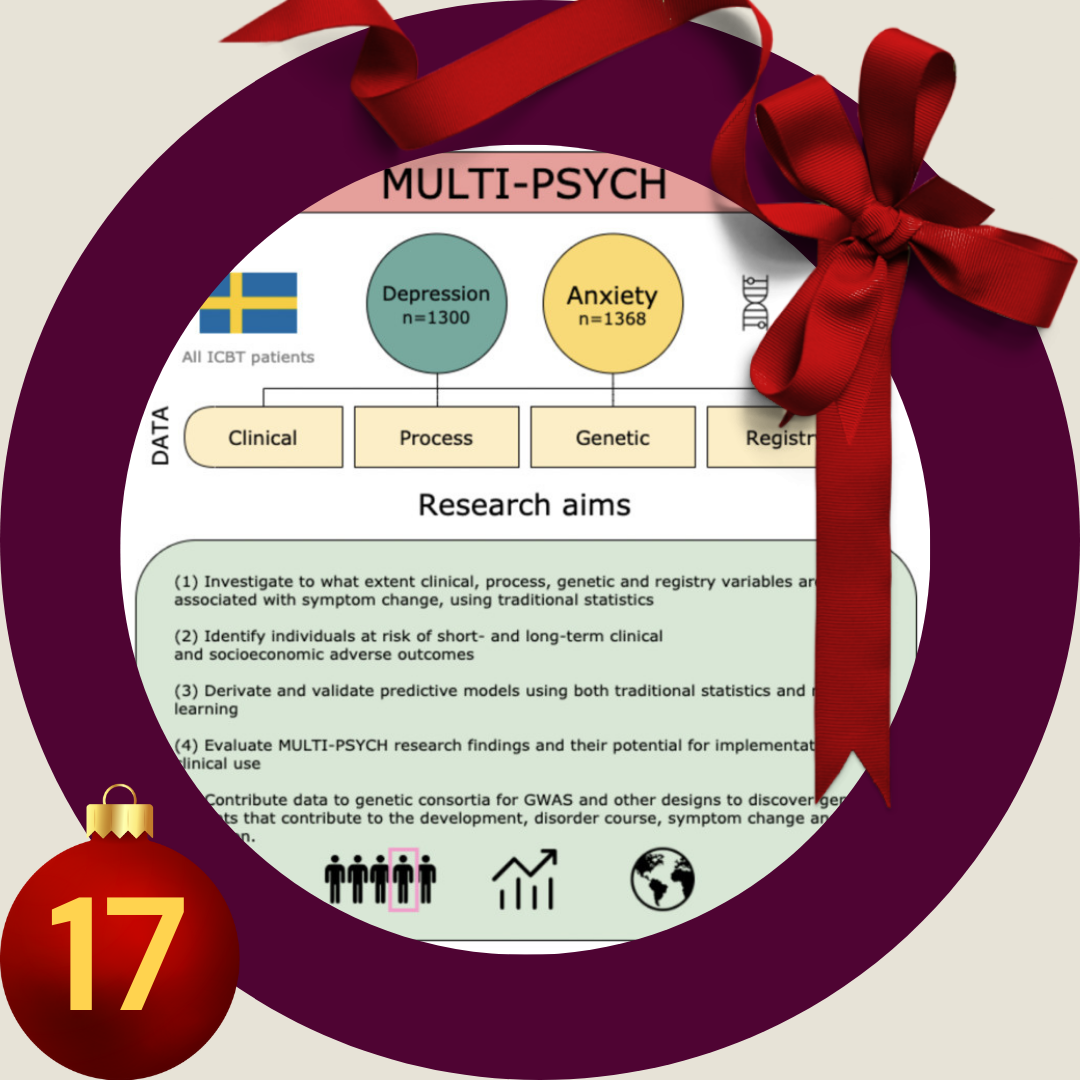
MULTI-PSYCH is a unique cohort of 2668 patients with anxiety and depression who have been treated with internet-delivered CBT. It contains clinical, genetic and nationwide registry data.
All patients have been blood sampled and genotyped. Clinical and genetic data has been linked to several Swedish registers containing a wide range of variables from patient birth up to 10 years after the end of ICBT.
These variables include:
Perinatal complications
School grades
Psychiatric and somatic comorbidity
Dispensed medications
Medical interventions and diagnoses
Health care and social benefits
Demographics
Income
The aim of the project is to improve risk stratification, outcome prediction, and secondary preventive interventions.
Our group has conducted research on internet-delivered cognitive behavior therapy in the past twelve years. In particular, the protocols for OCD (developed by Erik Andersson) and BDD (developed by Jesper Enander), have shown promising results in both Swedish and international clinical trials.
Since 2018, thanks to a massive effort by Lina Lundström, both treatments are implemented in the regular health care system in Sweden and can reach patients from Ystad to Pajala. This was critical during the COVID-19 pandemic when the health care system had to rearrange itself for remote delivery of care. We are proud that our digital treatments have helped thousands of patients overcome their struggles with OCD and BDD.
Sweden was the first country to introduce a zero vision for suicide. Manne Sjöstrand, with a background in medical ethics, discusses the ethical implications with such a vision as it risks contravening several ethical principles. The article further proposes a middle path for suicide prevention.
Looking back at the year, we can celebrate the successful defense of their theses by three doctoral candidates, marking significant achievements in the field.
We would like to take this opportunity to highlight Kärlekskoden – Sweden’s first dating handbook for people on the autism spectrum. Written by psychologists Sofia Asplund and Lisa Nordenstam, this guide offers practical advice on various aspects of dating, from asking someone out to understanding love and managing intimate relationships. It also features personal insights from several individuals on the spectrum, enriching the handbook with diverse experiences and perspectives.
What are the risk factors for suicide among psychiatric patients who have undergone compulsory mental care?
John Wallert‘s team with PhD student Leoni Grossman are investigating exactly this. The aim of the project is to apply epidemiological methods with a national 40-year cohort of registry data to investigate both the suicide risk itself and associated risk factors for compulsory mental care patients.
Today, we turn our focus towardMaria Bragesjö, who was recently honored with the prestigious European Association for Behavioural and Cognitive Therapies (EABCT) Scientist Practitioner Early Career Award. Congratulations, Maria!
PhD student Olly Kravchenko et al. use a new approach to predict how well patients with mental health issues respond to online therapy, utilizing polygenic risk scores and nationwide register data in addition to established predictors of treatment outcomes.
They found that novel predictors like ADHD and financial needs can affect therapy outcomes. The next step is to develop an intelligent machine learning model to make these predictions even more precise, helping tailor therapy to individual needs.
What are the main components in psychological treatment for obsessive-compulsive disorder? We asked PhD student and lic. Psychologist Max Sannemalm.
“The main component of psychological treatment for OCD is exposure with response prevention. Exposure is about exposing oneself to what triggers the obsessive thoughts and associated unpleasant feelings (such as anxiety, disgust or feelings of wrongness) and response prevention is about simultaneously refraining from compulsive acts, which is what you do that reduces the discomfort in the moment. That is, to get a good effect from the treatment, it is not enough just to expose yourself to different situations, response prevention is just as important.
The exercises during treatment can be in vivo exposure, that is exposing yourself to different physical situations in everyday life that you avoid. Another important part can be working with imaginary exposure, that is exposing oneself to different thoughts and scenarios that are perceived as frightening.
During the treatment, the exercises are tailored to the individual and early in the treatment, treatment goals are set to work towards. The overall goal is usually to live a life that is not controlled by OCD, but what this means and what you want to achieve will vary from person to person.
Psychological treatment for OCD can be provided in different formats – such as individual treatment, group treatment and internet-mediated treatment. The choice of format depends on both contextual and individual factors (for example, whether there are multiple diagnoses to consider during treatment, where you live and the severity of the compulsion) and the patient’s own preferences.”
Many do not know where to turn for help. In the first instance, you should contact your primary care provider (husläkare). If they are not able to provide the treatment you need, they can help you find a psychiatric clinic. Here we have listed a number of psychiatric clinics that are particularly good at assessing and treating OCD and related conditions.
What characterizes exhaustion disorder? Elin Lindsäter and her colleagues surveyed 573 people who had been diagnosed and 97 clinicians working with fatigue patients. The study showed a multidimensional presentation of symptoms (as illustrated in the picture) and that prolonged fatigue is a central domain.









 Rücklab - Psychiatry research at Karolinska Institutet