Introducing a multimodal cohort of patients with anxiety or depression treated with internet-delivered psychotherapy

Julia Boberg and colleagues recently published this paper on the MULTI-PSYCH- Swedish multimodal cohort of patients with anxiety or depression treated with internet-delivered psychotherapy.

As the title indicates, MULTI-PSYCH is a cohort of patients with anxiety and depression who have been treated with internet-delivered CBT. It is multi modal in the sense that it contains clinical, genetic and nationwide registry data.

MULTI-PSYCH is well positioned for research collaboration. Using MULTI-PSYCH, researchers can improve risk stratification, outcome prediction and secondary preventive interventions. It provides a unique infrastructure to study not only predictors or short-term treatment outcomes, but also longer term medical and socioeconomic outcomes in patients treated with ICBT for depression or anxiety.
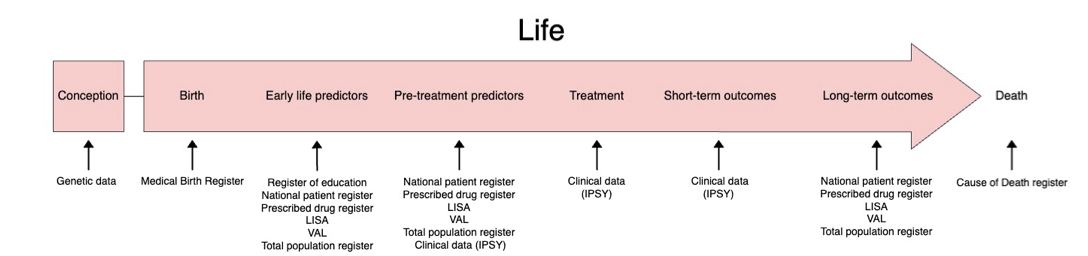
Data sources

Points about the cohort:

  • Includes 2668 clinically well-characterised adults with major depressive disorder, social anxiety disorder or panic disorder.
  • The patients are assessed before, during and after 12 weeks of ICBT.
  • All patients have been blood sampled and genotyped.
  • Clinical and genetic data is to several Swedish registers containing a wide range of variables from patient birth up to 10 years after the end of ICB. These variables include:
    • perinatal complications
    • school grades
    • psychiatric and somatic comorbidity
    • dispensed medications
    • medical interventions and diagnoses
    • healthcare and social benefits
    • demographics
    • income
    • more

Here is a link to the paper, where you can read more about the cohort and findings to date using the cohort.

Genetics of OCD

Julia Boberg – psychologist, PhD student and research group member – recently published a review article on the genetic epidemiology and molecular genetics studies of obsessive-compulsive disorder (OCD) and obsessive-compulsive symptoms.

Results

OCD is a heritable, polygenic disorder with contributions from both common and rare variants, including de novo deleterious variations. Multiple studies have provided reliable support for a large additive genetic contribution to liability to OCD, with discrete OCD symptom dimensions having both shared and unique genetic risks. Genome-wide association studies have not produced significant results yet, likely because of small sample sizes, but larger meta-analyses are forthcoming. Both twin and genome-wide studies show that OCD shares genetic risk with its comorbid conditions (e.g. Tourette syndrome and anorexia nervosa).

Conclusions

Despite significant efforts to uncover the genetic basis of OCD, the mechanistic understanding of how genetic and environmental risk factors interact and converge at the molecular level to result in OCD’s heterogeneous phenotype is still mostly unknown. Future investigations should increase ancestral genetic diversity, explore age and/or sex differ- ences in genetic risk for OCD and expand the study of pharmacogenetics, gene expression, gene × environment interactions and epigenetic mechanisms for OCD.

Read the full article here.