We would like to take this opportunity to highlight Kärlekskoden – Sweden’s first dating handbook for people on the autism spectrum. Written by psychologists Sofia Asplund and Lisa Nordenstam, this guide offers practical advice on various aspects of dating, from asking someone out to understanding love and managing intimate relationships. It also features personal insights from several individuals on the spectrum, enriching the handbook with diverse experiences and perspectives.
What are the risk factors for suicide among psychiatric patients who have undergone compulsory mental care?
John Wallert‘s team with PhD student Leoni Grossman are investigating exactly this. The aim of the project is to apply epidemiological methods with a national 40-year cohort of registry data to investigate both the suicide risk itself and associated risk factors for compulsory mental care patients.
Today, we turn our focus towardMaria Bragesjö, who was recently honored with the prestigious European Association for Behavioural and Cognitive Therapies (EABCT) Scientist Practitioner Early Career Award. Congratulations, Maria!
PhD student Olly Kravchenko et al. use a new approach to predict how well patients with mental health issues respond to online therapy, utilizing polygenic risk scores and nationwide register data in addition to established predictors of treatment outcomes.
They found that novel predictors like ADHD and financial needs can affect therapy outcomes. The next step is to develop an intelligent machine learning model to make these predictions even more precise, helping tailor therapy to individual needs.
What are the main components in psychological treatment for obsessive-compulsive disorder? We asked PhD student and lic. Psychologist Max Sannemalm.
“The main component of psychological treatment for OCD is exposure with response prevention. Exposure is about exposing oneself to what triggers the obsessive thoughts and associated unpleasant feelings (such as anxiety, disgust or feelings of wrongness) and response prevention is about simultaneously refraining from compulsive acts, which is what you do that reduces the discomfort in the moment. That is, to get a good effect from the treatment, it is not enough just to expose yourself to different situations, response prevention is just as important.
The exercises during treatment can be in vivo exposure, that is exposing yourself to different physical situations in everyday life that you avoid. Another important part can be working with imaginary exposure, that is exposing oneself to different thoughts and scenarios that are perceived as frightening.
During the treatment, the exercises are tailored to the individual and early in the treatment, treatment goals are set to work towards. The overall goal is usually to live a life that is not controlled by OCD, but what this means and what you want to achieve will vary from person to person.
Psychological treatment for OCD can be provided in different formats – such as individual treatment, group treatment and internet-mediated treatment. The choice of format depends on both contextual and individual factors (for example, whether there are multiple diagnoses to consider during treatment, where you live and the severity of the compulsion) and the patient’s own preferences.”
Many do not know where to turn for help. In the first instance, you should contact your primary care provider (husläkare). If they are not able to provide the treatment you need, they can help you find a psychiatric clinic. Here we have listed a number of psychiatric clinics that are particularly good at assessing and treating OCD and related conditions.
What characterizes exhaustion disorder? Elin Lindsäter and her colleagues surveyed 573 people who had been diagnosed and 97 clinicians working with fatigue patients. The study showed a multidimensional presentation of symptoms (as illustrated in the picture) and that prolonged fatigue is a central domain.
Christian’s new book, Ett liv värt att leva (A Life Worth Living), will be published in January. The book takes us through the theme suicide through different perspectives and human stories. What can we learn from the existence of suicide?
🧠 🏋️♀️How can healthcare providers motivate individuals with depression, anxiety, and stress? Braining could be the answer!
Given the widely recognized benefits of physical exercise, a unique training program was initiated by Lina Martinsson, together with PhD student Åsa Anger, at Affektiva mottagningen Psykiatri Sydväst, Karolinska Huddinge. The program involves group exercise three times a week for three months, benefiting both patients and healthcare staff.
Braining reached over 700 patients aged 18-80 years during 2017-2022!
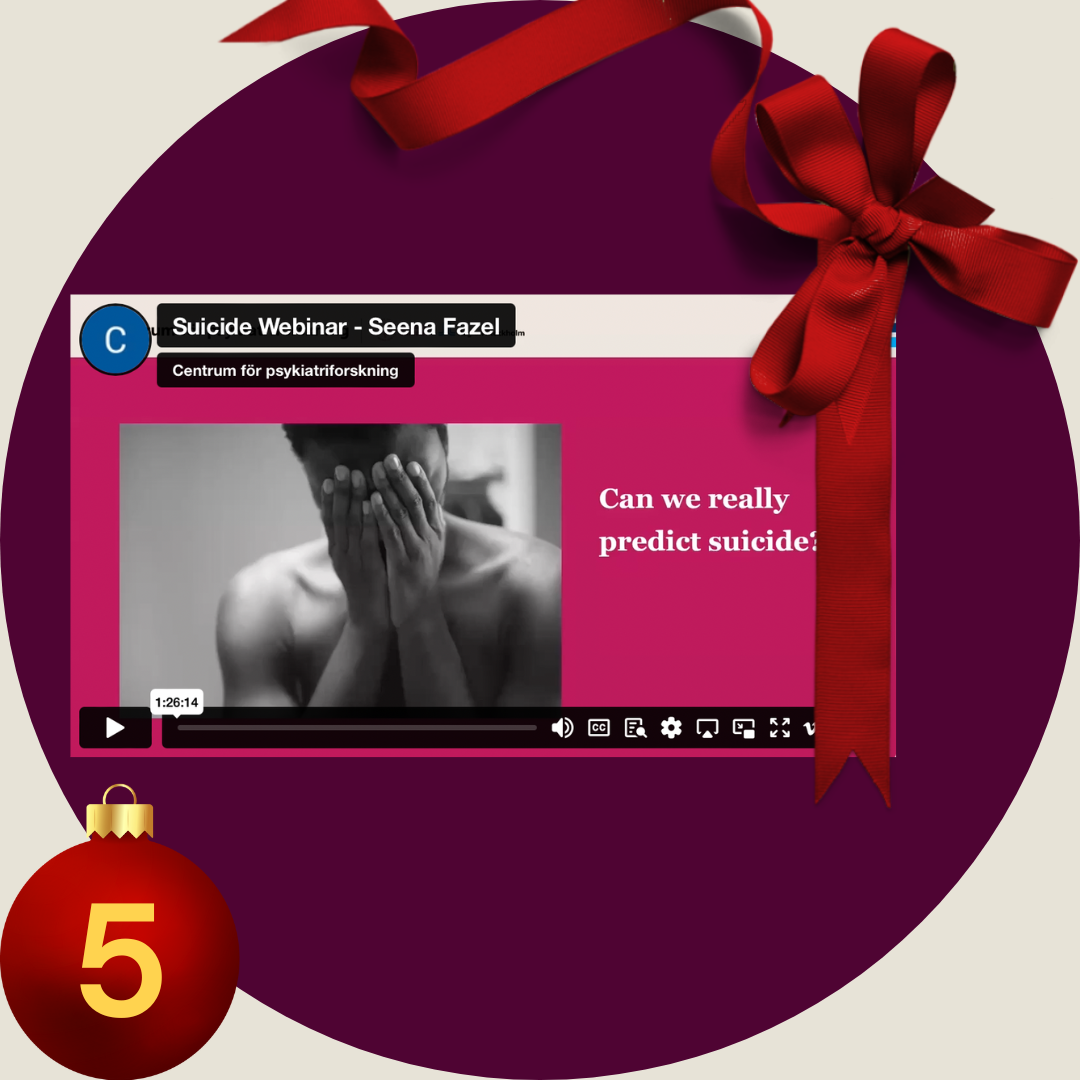
Don’t miss the intriguing series on suicide hosted by Christian Rück and The Centre for psychiatry research at Karolinska Institutet. Missed some? No worries, they’re all recorded.
In this seminar, Professor of Forensic Psychiatry Seena Fazel from Oxford University gives a lecture on the topic “Can We Really Predict Suicide?” where he gives an overview of the latest evidence on suicide prediction using new methods.
The mental illness jar – A metaphor for how vulnerability to mental illness develops as an interaction between genetic and environmental factors, and the role of protective factors. 🥫






 Rücklab - Psychiatry research at Karolinska Institutet