Jesper Enander to defend thesis on May 5th

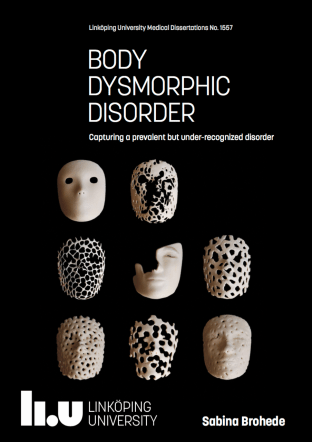
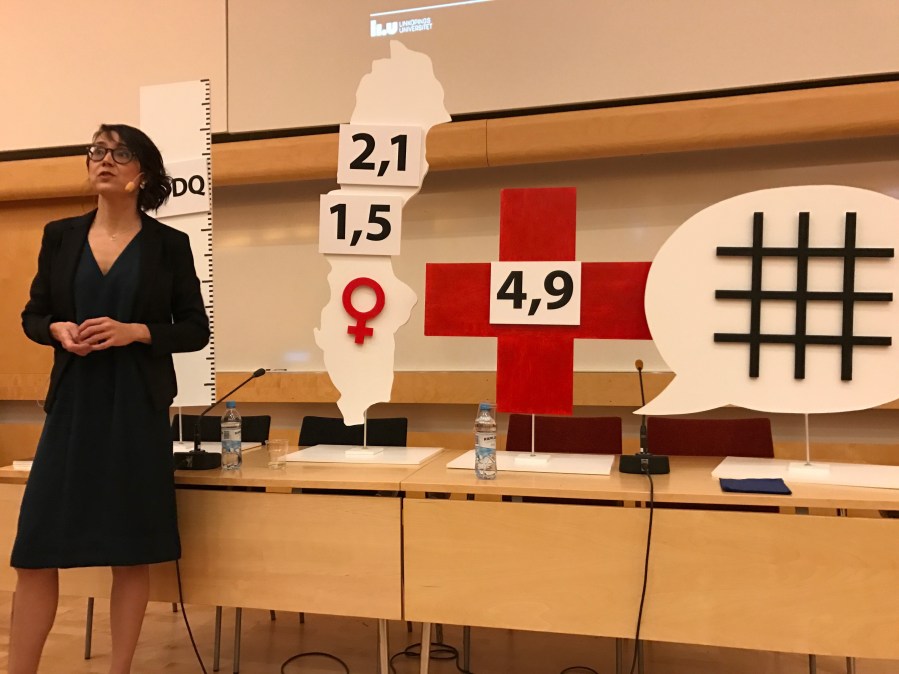
Jesper is about to defend his thesis titled: “Etiology, prevalence, and development of a novel treatement for body dysmorphic disorder” May 5 at 09.00 in Lecture hall H1, Alfred Nobels Allé 23, Campus Flemingsberg. Do not miss! 

His Opponent will be Professor Ulrike Buhlman, University of Münster.

Examination Board:
Associate Professor Kalle Lundgren, Karolinska Institutet, Department of Molecular Medicine and Surgery

Professor Klaas Wijma, Linköping University, Department of Clinical and Experimental Medicine

Professor Jerker Hetta, Karolinska Institutet, Department of Clinical Neuroscience

Principal Supervisor:
Associate Professor Christian Rück, Karolinska Institutet, Department of Clinical Neuroscience

Co-supervisors:
Professor David Mataix-Cols, Karolinska Institutet, Department of Clinical Neuroscience

Professor Paul Lichtenstein, Karolinska Institutet, Department of Medical Epidemiology and Biostatistics

Associate Professor Brjánn Ljótsson, Karolinska Institutet, Department of Clinical Neuroscience

Fabian Lenhard to defend thesis

Don’t miss our dearest Fabian Lenhard’s thesis

to be publicly defended Friday March 23. Details on where here: http://ki.se/cns/kalender/disputation-fabian-lenhard

Your can download his thesis here: https://openarchive.ki.se/xmlui/handle/10616/45535

IMG_2941

New meta-analysis in JAMA Psychiatry: Does d-cycoserine add to CBT?

D-cycloserine (DCS) is a partial NMDA agonist that facilitates fear extinction in animals and reduces return of fear when given before  extinction training. Despite several initial trials showing promising results in humans with anxiety disorders larger trials conducted within the past 5 years have produced mixed results. Our large trial in obsessive-compulsive disorder22 found no general effect of DCS but a significant interaction effect between DCS and antidepressant medication in a post hoc analysis;  antidepressants impaired treatment response in patients randomized to DCS but not in patients randomized to placebo.

We collected Individual participant data for 21 of 22 DCS trials, representing 1047 of 1073 eligible participants. When controlling for antidepressant use, participants receiving DCS showed greater improvement from pretreatment to posttreatment (mean difference, −3.62; 95% CI, −0.81 to −6.43; P = .01; d = −0.25) but not from pretreatment to midtreatment (mean difference, −1.66; 95% CI, −1.60 to 4.92; P = .32; d = −0.14) or from pretreatment to follow-up (mean difference, −2.98, 95% CI, −0.03 to 5.99; P = .05; d = −0.19). Only 1 significant moderator emerged: year of publication. Specifically, the more recent the study, the smaller the difference between DCS and placebo for pretreatment to follow-up improvement (b = 4.02; 95% CI, 0.59-7.45; P = .02, d = 0.26).

Conclusion: D-cycloserine is associated with a small augmentation effect on exposure-based therapy. The small size of the effect makes the clinical usefulness of DCS doubtful.


Mataix-Cols D, Fernández de la Cruz L, Monzani B, Rosenfield D, Andersson E, Pérez-Vigil A, Frumento P, de Kleine RA, Difede J, Dunlop BW, Farrell LJ, Geller D, Gerardi M, Guastella AJ, Hofmann SG, Hendriks G, Kushner MG, Lee FS, Lenze EJ, Levinson CA, McConnell H, Otto MW, Plag J, Pollack MH, Ressler KJ, Rodebaugh TL, Rothbaum BO, Scheeringa MS, Siewert-Siegmund A, Smits JAJ, Storch EA, Ströhle A, Tart CD, Tolin DF, van Minnen A, Waters AM, Weems CF, Wilhelm S, Wyka K, Davis M, Rück C, for the DCS Anxiety Consortium. D-Cycloserine Augmentation of Exposure-Based Cognitive Behavior Therapy for Anxiety, Obsessive-Compulsive, and Posttraumatic Stress DisordersA Systematic Review and Meta-analysisJAMA Psychiatry. Published online January 25, 2017. doi:10.1001/jamapsychiatry.2016.3955


Our 2016 in review

While the world around us may have had a perplexing year, we have in fact had a great year  when it comes to research.

Here is a review of some of what has happened in our group:

In our own humble opinion we have published some landmark studies:

A large randomised controlled trial of internet-based CBT for Body Dysmorphic Disorder, showing excellent results, published in the BMJ with Jesper Enander as lead author.

The largest study so far looking at risk factors around birth in Obsessive-Compulsive Disorder (OCD), published in JAMA Psychiatry with Gustaf Brander as lead and David Mataix-Cols as senior author. This study to me also shows the power of Swedish national registries.

The largest study so far looking at suicide in OCD and finding a much higher suicide rate than expected. Lead author is the brilliant Lorena Fernandez de la Cruz and this master piece out of the Mataix-Cols kitchen was published in Molecular Psychiatry. A similar study on tic disorders was also published in Biological Psychiatry.

Fabian Lenhard pioneered the first randomised study looking at ICBT for adolescents our neighbouring research group of Eva Serlachius. It was just published in JAACAP.

What else did we publish in 2016? Check https://rucklab.com/publications/

Genetics: major study started and harvest time for some

We have started a new big study trying to understand the complex genetical architecture of OCD and related disorders. You can read more about the study here. Good news is that data collection is going well (=lots of DNA) and that we in this year have built a lot of infrastructure to ensure a bright future for the project.

We are collecting samples at 8 centers in Sweden and this study is part of a larger Nordic effort called, yes, NORDiC! Read all about NORDiC here: http://www.crowleylab.org/nordic

nordic_logo

We have DNA from about 2500 individuals who have undergone internet-CBT for other anxiety disorders and depression. It is now harvest time for some of that, data is being analysed at different sites in Europe with Evelyn Andersson as the coordinating PhD student.

New people

Oskar Flygare has secured a CSTP-grant and will start a PhD early next year in tight collaboration with Lina Lundström.

Annelie Porsborn, Julia Boberg and Susanne Alm are our new front-line soldiers, all employed in the OCD genetics project.

Long-Long Chen and Mia Asplund are both hang-arounds likely to go into a PhD next year on poo bacteria, Deep Brain Stimulation and skin-picking and hair-pulling. What a mix!

*********

A special shout out to Volen Ivanov who has tirelessly educated hundreds of people in the social services on Hoarding Disorder!

We wish you all a great 2017! Thank YOU to all our collaborators, research subjects, readers and funders!

End of a trial

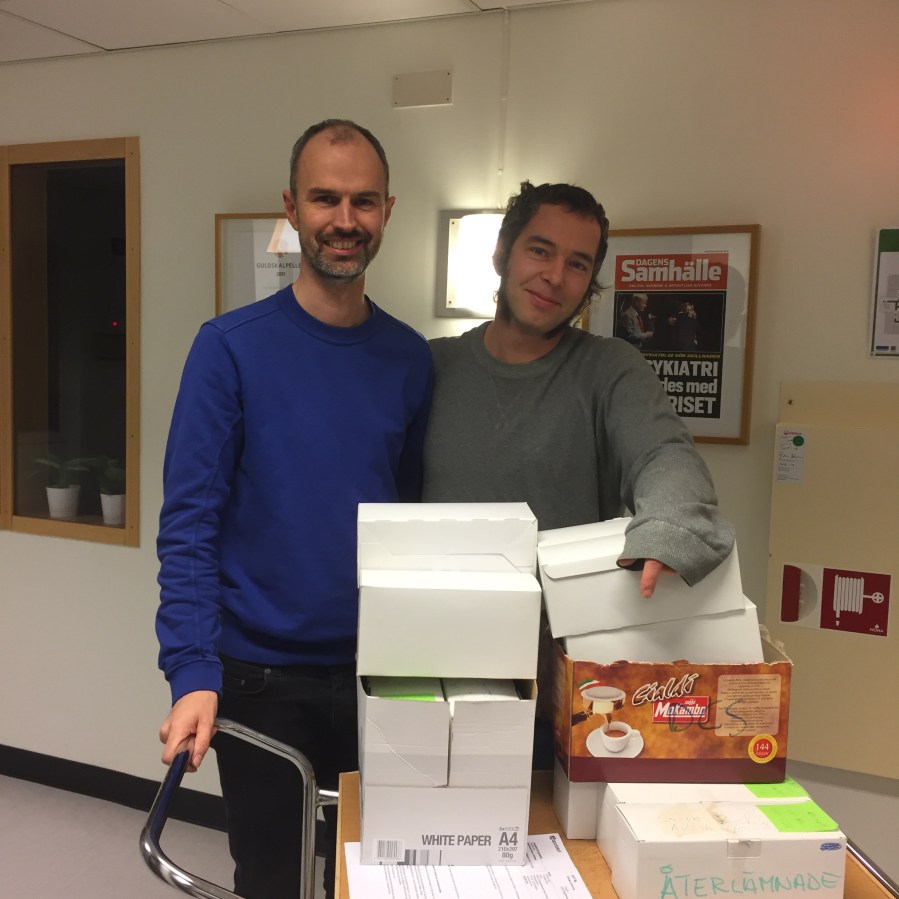
Last week we had the honor of being visited by a lab alumni, Erik Andersson. It was time to close and archive our trial where we tested the efficacy of d-cycloserine as an add on to CBT for OCD. You can read the results of that trial here in Jama Psychiatry. Now all the follow-ups are done and it was time to close the trial, send the end-of-trial forms to the Swedish Medical Products agency and to return the drugs to the pharmacy.

It was really a trip down memory lane, remembering how we got APL Pharmaceuticals to produce both the drug and placebo, the massive workload for all approvals and the task of actually get such a big trial done. Broke the bank and got us a few gray hairs. Good news is that the treatment with internet-based CBT in the trial was very helpful for the participants.

img_0664
Erik saying a a few last words to the capsule before going to destruction.
img_0672
Still smiling after all these years.

Vi söker en forskningssjuksköterska

Vi söker en tredje forskningssjuksköterska i vårt stora genetikprojekt. Vill du vara med i världens största studie för att förstå tvångssyndromets genetiska bakgrund? Vi vill bli en till i vårt team! Läs mer på https://ki.mynetworkglobal.com/se/what:job/jobID:123067/where:4/

Are differences in cardiac autonomic function (heart rate and blood pressure) associated with later psychiatric disorders? New study in JAMA Psychiatry

In this longitudinal cohort study of more than 1 million men in Sweden, a higher resting heart rate in late adolescence was associated with an increased risk for subsequent obsessive-compulsive disorder, schizophrenia, and anxiety disorders, whereas a lower resting heart rate in late adolescence was associated with an increased risk for substance use disorders and violent criminality. Similar associations were observed with systolic/diastolic blood pressure.

Read the full paper here. 

Latvala A, Kuja-Halkola R, Rück C, D’Onofrio BM, Jernberg T, Almqvist C, Mataix-Cols D, Larsson H, Lichtenstein P. Association of Resting Heart Rate and Blood Pressure in Late Adolescence With Subsequent Mental DisordersA Longitudinal Population Study of More Than 1 Million Men in SwedenJAMA Psychiatry. Published online October 26, 2016. doi:10.1001/jamapsychiatry.2016.2717