Introducing a multimodal cohort of patients with anxiety or depression treated with internet-delivered psychotherapy

Julia Boberg and colleagues recently published this paper on the MULTI-PSYCH- Swedish multimodal cohort of patients with anxiety or depression treated with internet-delivered psychotherapy.

As the title indicates, MULTI-PSYCH is a cohort of patients with anxiety and depression who have been treated with internet-delivered CBT. It is multi modal in the sense that it contains clinical, genetic and nationwide registry data.

MULTI-PSYCH is well positioned for research collaboration. Using MULTI-PSYCH, researchers can improve risk stratification, outcome prediction and secondary preventive interventions. It provides a unique infrastructure to study not only predictors or short-term treatment outcomes, but also longer term medical and socioeconomic outcomes in patients treated with ICBT for depression or anxiety.
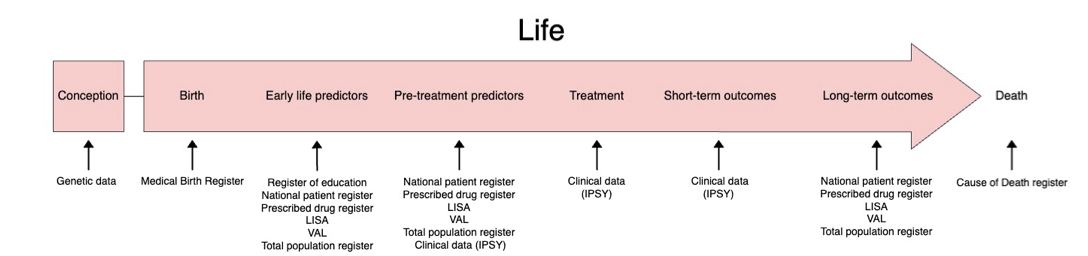
Data sources

Points about the cohort:

  • Includes 2668 clinically well-characterised adults with major depressive disorder, social anxiety disorder or panic disorder.
  • The patients are assessed before, during and after 12 weeks of ICBT.
  • All patients have been blood sampled and genotyped.
  • Clinical and genetic data is to several Swedish registers containing a wide range of variables from patient birth up to 10 years after the end of ICB. These variables include:
    • perinatal complications
    • school grades
    • psychiatric and somatic comorbidity
    • dispensed medications
    • medical interventions and diagnoses
    • healthcare and social benefits
    • demographics
    • income
    • more

Here is a link to the paper, where you can read more about the cohort and findings to date using the cohort.

Olly on internet treatment conference

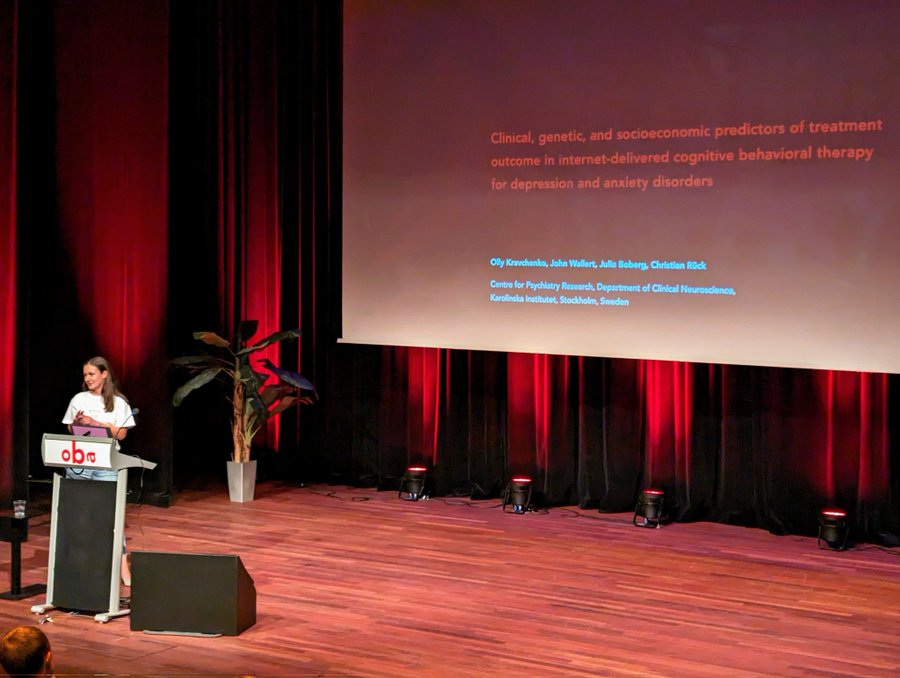
At the beginning of the month, Olly Kravchenko attended the European Society for Research on Internet Interventions (ESRII) conference in Amsterdam.

She talked about her work on predictors of outcome in internet-delivered CBT for anxiety and depression.

The story: She leveraged the unique data we have available (clinical, genetic and register-based) to potentially establish new predictors of treatment outcome. Then she tested: Do genetic and register data better explain variance in treatment outcome if compared to the clinical data readily available in routine care? – They did not!

Next step is to develop machine learning model and see if it performs better.

Thanks for looking into this Olly, we need to find out more!

Braining on Swedish Radio

In the latest episode of Louise Epstein’s podcast, together with Anders Hansen, we can hear Lina Martinsson talk about the Braining initiative!

Braining – training for the brain – is an initiative from Psychiatry Southwest, Huddinge Hospital where patients and staff exercise together. The project stems from the fact that we know that exercise is good for mental wellbeing and has an effect on depression, but it’s difficult to get patients to do it.

How much do you need to exercise to have an effect on mental health and how do you do it? Listen and learn. The podcast even includes a live clip from the hospital park in Huddinge.

Here is a link to the episode.

Psst…! Åsa Anger, Lina and colleagues published the first scientific article on Braining this summer, click here to read it.

Olly’s ISP seminar

Today, Olly held her individual study plan (ISP) seminar for her doctoral studies. The overall purpose of the studies is to enhance the prediction of health and socioeconomic outcomes in patients with common psychiatric disorders, such as depression and anxiety.

We know that 25-50% of patients with depression and anxiety disorders don’t respond to CBT. These patients may benefit from alternative or tailored treatment formats. We want to explore ways to help them, but in order to do that we need to predict who they are. Existing predictive models of treatment outcome are usually based on clinical data with a small set of predictors which results in low predictive power and limited clinical utility.

Olly’s PhD project will use a big sample from Psykiatri Sydväst’s Internet Psychiatry and predict treatment outcomes for multiple disorders. It will use clinical, genetic and register data to predict both treatment response and long-term socioeconomic disadvantage such as labour market marginalization.

The work consists of four studies.

  • Study 1: Clinical, socioeconomic and genetic predictors of treatment outcomes in internet-delivered cognitive behavioral therapy for depression and anxiety disorders
  • Study 2: Development of a machine learning model to predict response to ICBT treatment at the individual subject level
  • Study 3: Development of a machine learning model aimed at predicting labour market marginalization
  • Study 4: Validation of the model from study 2 in clinical practice

Olly’s main supervisor is Christian, and her co-supervisor is John.

We look forward to this!

The association between depression and anxiety and myocardial infarction

In a freshly published article, Oskar et al. have delved into the connection between depression, anxiety and myocardial infarction (MI).

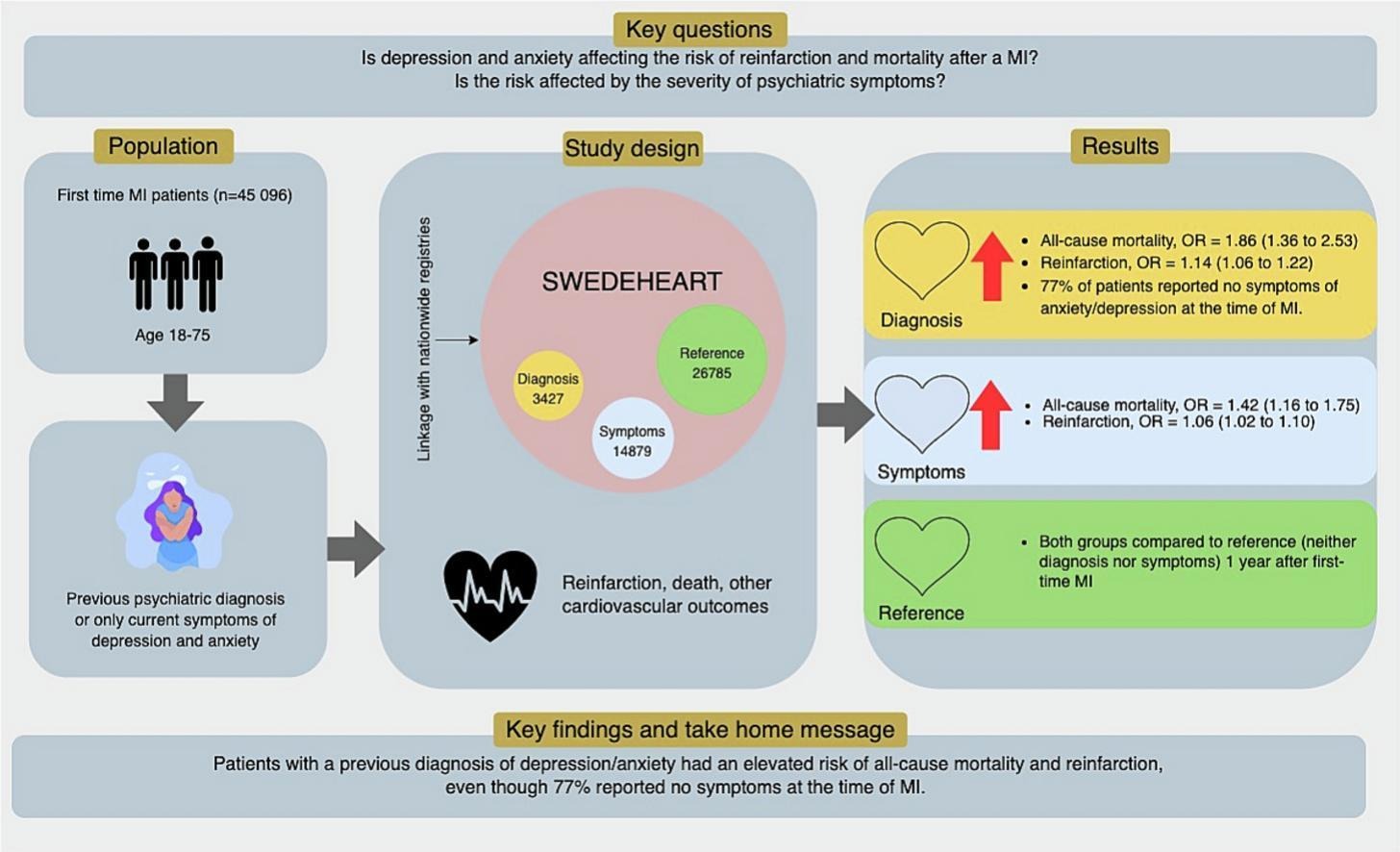
Linking demographic, socioeconomic and clinical data from four nationwide Swedish registries, they found that both a previous diagnosis, and present self-reported symptoms of anxiety or depression are associated with an increased risk of death and recurrent cardiovascular events in adults with first-time MI.

Patients with a diagnosis had a higher risk for MI, even though 77% reported no symptoms at the time of MI. That is, only screening for present symptoms is inadequate for assessing this excessive risk. Assessment of both psychiatric history and self-reported symptoms seems warranted for these patients.

Read the article here.

Graphical abstract

Two new publications:

On iCBT for Symptoms of Anxiety and Depression After Myocardial Infarction, and Cognitive Dedifferentiation in Abnormal Cognitive Decline

This week, John Wallert published not one but two articles! 🎉

  1. Internet-Based Cognitive Behavioral Therapy for Patients Reporting Symptoms of Anxiety and Depression After Myocardial Infarction: U-CARE Heart Randomized Controlled Trial Twelve-Month Follow-up

    The aim of this study was to evaluate the long-term effectiveness of internet-based cognitive behavioral therapy on self-reported symptoms of anxiety and depression in patients 12 months after a myocardial infarction and to explore subsequent occurrences of cardiovascular disease events. Shortly after acute myocardial infarction, 239 patients reporting mild-to-moderate symptoms of anxiety or depression were randomized to 14 weeks of therapist-guided internet-based cognitive behavioral therapy (n=117) or treatment as usual (n=122). 

    The study’s conclusions was that internet-based cognitive behavioral therapy was not superior in reducing self-reported symptoms of depression or anxiety compared to treatment as usual at the 1-year follow-up after myocardial infarction. A reduction in cardiac-related anxiety was observed but was not significant after adjusting for multiple comparisons. There was no difference in risk of cardiovascular events between the treatment groups. Low treatment adherence, which might have affected treatment engagement and outcomes, should be considered when interpreting these results.

  2. Cognitive dedifferentiation as a function of cognitive impairment in the ADNI and MemClin cohorts

    The cause of cognitive dedifferentiation has been suggested as specific to late-life abnormal cognitive decline rather than a general feature of aging. This hypothesis was tested in two large cohorts with different characteristics. The subjects came from two research databases in North America and Sweden. Dedifferentiation was explained by cognitive impairment when controlling for age, sex, and education. This finding replicated across two separate, large cohorts of older individuals. Knowledge that the structure of human cognition becomes less diversified and more dependent on general intelligence as a function of cognitive impairment should inform clinical assessment and care for these patients as their neurodegeneration progresses.