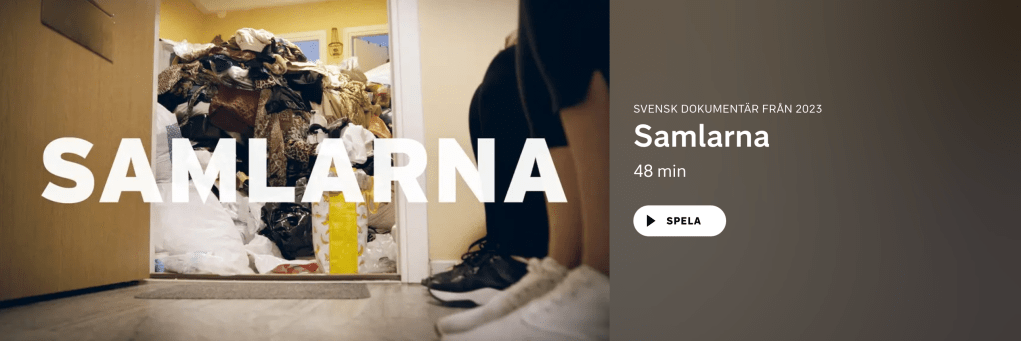
Volen och Sofia i SVT’s Samlarna

The documentary Samlarna is now up on SVT Play. Samlarna is a film by Linnea Widén about hoarding disorder, portraying people with problematic hoarding behavior. Volen and Sofia are participating in the film, in a task force meeting where different partakers working with hoarding disorder meet and work together.

Hoarding disorder is still a relatively unknown disorder, especially considering that as many as 2,5 % of the population is believed to suffer from it. The film include portraits of people living with this condition. We believe that this documentary play a role in increasing knowledge about the disorder and the patiens struggling with it.

We are currently conducting a study testing a new treatment for patients with hoarding disorder. The new treatment consists of a combination of CBT and home de-cluttering. We compare the treatment with CBT only. Read more about the study here.

The documentary is already up on SVT Play, and broadcasted on SVT1 on Thursday, January 19th.

Two grants to Katja

Ekaterina Ivanova has received not one but TWO grants from Swedish Society of Medicine (Svenska Läkaresällskapet), the post doc grant and the project grant.

Both of the grants are for the Bergen 4 Day treatment project, an RCT testing the non-inferiority, speed of recovery, and cost-effectiveness of Bergen 4-Day Treatment (B4DT) for obsessive compulsive disorder (OCD), compared to gold-standard CBT.

Read more about the Bergen 4 Day treatment-project here.

Congratulations Katja! 🎺🎺🎺

Grant for suicide research

We have received $1,494,898 from the American Foundation for Suicide Prevention (AFSP) for the Saving Lives project!

The project aims to improve precision in prediction and prevention of suicide by constructing a national cohort of genetic and environmental data. The ultimate goal is to decrease suicide rates.

Suicide is a tragic event for the individual, the relatives and society. We therefore make efforts to prevent suicide, and a typical way of doing this is to assess suicide risk. Still, studies in psychiatric populations show that current assessments available will classify one out of two suicidal individuals as low risk before an actual death by suicide, while 95% of those classified as high risk will eventually not die by suicide.

Why?

The causes of suicide are complex. Many different factors and life events contribute. To improve prediction, large studies and long follow-up are needed to reach meaningful sample sizes.

Using unique Swedish assets, of genetic and environmental data, and machine learning we have an opportunity a discover environmental and genetic risk factors associated with suicide in order to predict and prevent it.

We thank the AFSP for this grant.

Read more about the Saving lives project here.

Besväras du av tvångstankar eller tvångshandlingar?

Vi har just öppnat anmälan till en studie som jämför två olika behandlingsformer för personer med tvångssyndrom.

Läs mer och anmäl dig här: www.ocdprojektet.se

Kognitiv beteendeterapi (KBT) har visat sig vara effektivt för att lindra både tvångstankar och tvångshandlingar när den genomförs under 14 veckor. Karolinska Institutet och Region Stockholm genomför nu en studie som jämför denna typ av KBT med en intensivbehandling som pågår i 4 heldagar.

Mer information

  • Du behöver vara minst 18 år och ha tvångssyndrom (OCD)
  • Behandlingen genomförs på Karolinska sjukhuset i Huddinge eller Solna
  • Deltagandet är gratis

English translation: We have opened the registration for an RCT comparing a new concentrated treatment for OCD to golden standard CBT.

PhD position in Precision Psychiatry available

We are looking for a new doctoral student to join our computational team!

Read more and apply here.

Do you want to contribute to top quality medical research?

In the research group we work to improve the lives of individuals with psychiatric conditions. A core theme of our research is to develop more accurate prediction models for both the risk of, and also consequences of, psychiatric conditions.

The main scientific objective of your PhD project is to advance knowledge in suicide prediction. Suicide is a catastrophic event for the individual, close relatives, colleagues, and society. Your project is focused on statistical modelling in two different studies. In both studies you will collaborate with colleagues at Oxford University (UK), University of North Carolina Chapel Hill (US) and Sweden.

🎯Research project 1 is a registry study of risk factors for suicide among psychiatric patients that have experienced compulsive mental care.

🎯Research project 2 you will be working with multimodal data (including genetic data) in a nationwide suicide cohort with the purpose of improving present prediction of suicide aiming to derive and validate better risk models for suicide in the total population.

The position is a part of the Rücklab computational team, led by John Wallert.

We look forward to receiving your application!

New article on the feasibility of digital acceptance based BT for trichotillomania and skin-picking

Mia Asplund et al have looked into the feasibility of internet-delivered acceptance based behavioral therapy (BT) for trichotillomania (TTM) and skin-picking disorder (SPD).

Click here to read the article.

Short summary:

25 clinical-referred patients with TTM and SPD underwent internet-delivered BT for 10 weeks. The treatment involved both traditional interventions such as habit reversal and more acceptance based strategies.

A majority of the participants were satisfied with the treatment and found it credible. Hair pulling and skin picking severity decreased significantly from pretreatment to posttreatment, and most outcome measures remained significant at the 12-month follow-up.

Taken together, he results provide initial evidence suggesting that I-BT could be a feasible, acceptable and potentially effective treatment for TTM and SPD.

👏👏👏👏

Registration open for study on internet-delivered prolonged exposure for PTSD

The registration is now open for our study investigating the feasibility of internet-delivered prolonged exposure for patients with post-traumatic stress disorder (PTSD).

Click here if you are interested in participating in the study, receiving internet-delivered psychological treatment for PTSD (Swedish)

Psychological treatments, commonly using trauma focused cognitive-behavioral techniques, like prolonged exposure (PE) are today recommended as first-line treatments for PTSD. Unfortunately, this treatment is not available to everyone who needs it. Therefore, we are investigating the feasibility of internet-delivered prolonged exposure for patients with PTSD.

Primal investigator of the project is Maria Bragesjö.

Anmälan till studie om hälsoångest

Oroar du dig väldigt mycket över din hälsa?

Vill du på egen hand jobba med ett digitalt verktyg för att hitta sätt att hantera den här oron?

Karolinska Institutet undersöker just nu om ett digitalt egenvårdsprogram kan hjälpa personer som besväras av hälsoångest. 

Med hälsoångest menas: 

  • En stark och ihållande rädsla för att vara eller bli allvarligt sjuk
  • Rädslan är överdriven i förhållande till den verkliga risken och medför stort lidande eller begräsning i vardagen
  • Rädslan leder till olika strategier såsom att söka information om sjukdomar, kontroll av kroppen eller undvikanden av aktiviteter.

Studien pågår under 8 veckor och sker helt via dator/smartphone. Deltagare över 18 år från hela landet är välkomna att anmäla sig.

Läs mer / gör intresseanmälan på: https://egenvard.webcbt.se/registration/16644

Kontakt:
Projektledare: Susanna Österman, leg psykolog och doktorand
susanna.osterman@ki.se, 0708842418

Ansvarig forskare: Martin Kraepelien, leg psykolog och med dr. 
martin.kraepelien@rucklab

English translation: We are now including participants for a study testing a digital self-care program for people suffering from health anxiety. Project manager is Susanna Österman, PhD student in our research group.

New publication from the statistical modelling team!

The article Predicting remission after internet-delivered psychotherapy in patients with depression using machine learning and multi-modal data is now published in Translational Psychiatry and ready to be read and spread.  

The study applied supervised machine learning with multi-modal data to predict remission of major depressive disorder after internet-delivered psychotherapy. Predictor types were demographic, clinical, process, and genetic and outcome was remission status post ICBT. Transparency analysis showed model usage of all predictor types at both the group and individual patient level. Future iterations of the derived and validated model may inform tailored intervention before initiating ICBT for MDD. The multi-modal approach to predict remission in these patients holds promise and warrants further investigation to establish clinical utility.

The authors are John Wallert, Julia Boberg, Viktor Kaldo, David Mataix-Cols, Oskar Flygare, James Crowley, Matthew Halvorsen, Fehmi Ben Abdesslem, Magnus Boman, Evelyn Andersson, Nils Hentati Isacsson, Ekaterina Ivanova and Christian Rück.

Read the article here.