Postdoc Maria Bragesjö is currently working on two novel treatment formats for PTSD: intensive trauma focused treatment and digital prolonged exposure. These treatment formats have the potential to be more effective, cost-effective and tolerable for patients than existing treatments, while increasing accessibility for those who need help.
We recommend watching the documentary Samlarna by Linnea Widén on SVT. The film portrays people suffering from hoarding disorder. And be sure to keep an eye out for our beautiful hoarding experts Volen Ivanov and Sofia Jägholm.
🎄✨ Countdown to Christmas! We’re happy to announce Rücklab’s 24-Day Christmas Calendar! Starting today, join us in a festive journey as we unveil a new post every day leading up to Christmas.
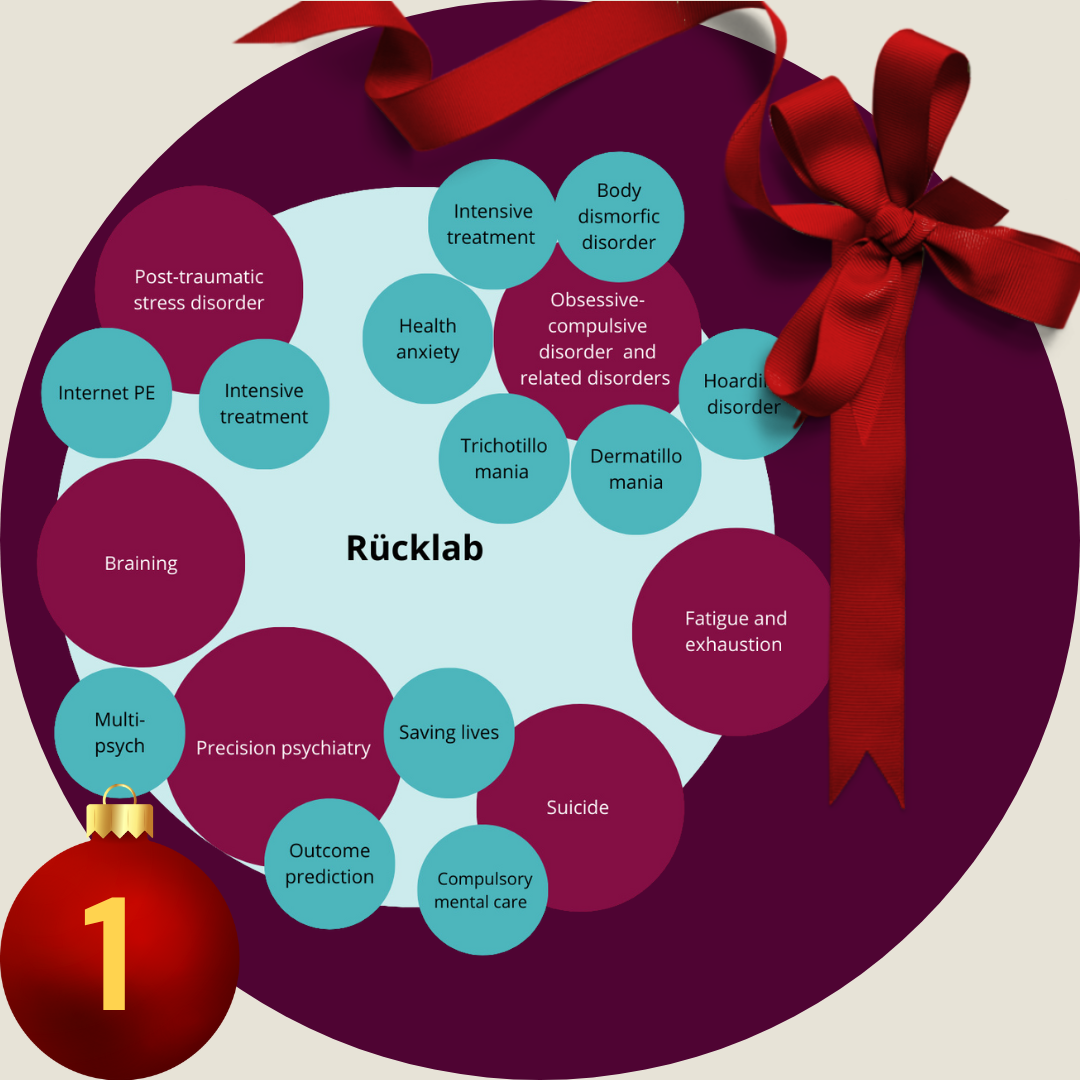
Let’s start by introducing ourselves. Rücklab works in a wide range of areas of psychiatric research: OCD, suicide, fatigue, PTSD and precision psychiatry.
Yesterday, Max made an outstanding appearance on TV4 Efter fem talking about obsessive-compulsive disorder and the Bergen study. The Bergen 4-day treatment compares an intensive treatment format of four consecutive days of combined group and individual therapy with gold-standard weekly treatment.
Recently, you may have come across our research in your daily podcast feed.
In Beslutspodden, Lina Martinsson – research team leader and operations manager at Psykiatri Sydväst – visits and talks about her career as a reserarcher/clinician/manager. Lina runs the Braining project – physical activity in a clinical setting, involving both patients and clinicians.
We also noticed that our Bergen 4 day treatment non-inferiority RCT for OCD was mentioned in the Daddy Issues podcast a while ago. Julia Lyskova talks about her experience of being a participant in the study’s intensive treatment study arm. She describes her OCD-related problems and the extent to which they have affected her daily life and well-being. “I have thought that I have killed everyone I love”, Lyskova says in the podcast, summarizing what it can feel like to live with the disorder. She also describes her ambivalence about participating and approaching what she is afraid of, how much willpower is required to attend the treatment and the experience of improvement.
Take the time to listen to these two podcasts that bridge research and reality.
In the episode, she explains the difference between trauma as used in everyday speech and PTSD as a psychiatric diagnosis. Trauma in PTSD means that the person has been exposed to a threat, violence or accident that has caused fear for their life. In addition, the diagnosis includes criteria such as re-experiencing, avoidance and increased vigilance.
Intensive treatment for PTSD (I-PE) – An RCT investigating the effect, speed of recovery, and cost-effectiveness of intensive treatment for post-traumatic stress disorder (PTSD), compared to gold-standard trauma focused CBT. Read more about the project here.
Digital PE for PTSD – A feasibility study of internet-delivered prolonged exposure for patients with PTSD. Read more about the project here.
Great news for patients suffering from – and clinicians dealing with – fatigue and exhaustion: Elin Lindsäter has received a 5 million SEK grant from Forte for her project on new methods for assessment and treatment in primary care for fatigue as a transdiagnostic symptom dimension.
Elin and her team have been approaching the issue of fatigue and exhaustion disorder (ED, svenska: utmattningssyndrom) for several years. In a qualitative study aimed at broadening the understanding of the symptoms of the condition, they found that fatigue is the core symptom of ED. Fatigue is also a central symptom in other conditions, such as multiple sclerosis, type 1 diabetes and post COVID-19. Looking at fatigue as a transdiagnostic symptom instead of, for example, the specifically Swedish diagnosis of ED enables treatment of other conditions where patients experience fatigue. Moreover, researchers can work cumulatively from the international fatigue research instead of the limited diagnosis-specific field of ED.
Congratulation Elin et al.! This research will benefit many patients suffering from disabling fatigue.
Christian and Olly recently participated in the World Congress of Psychiatric Genetics (WCPG) in Montreal.
Rücklab closely collaborates with Psychiatric Genomics Consortium (PGC) within genetics of depression, anxiety disorders, OCD, suicide and ICBT treatment response. This year, Christian and Olly presented two posters highlighting their ongoing work in prediction of ICBT treatment outcome where polygenic risk scores are used as one of potential predictors.
Olly presenting one of the posters to curious conference attendees.
Here are some take away-points from the conference by Olly:
Larger sample sizes: Sample sizes are becoming larger, increasing the number of identified genetic risk variants associated with liability to psychiatric disorders. Multiple biobanks and clinical research groups combine their data with direct-to-consumer genetic testing companies, such as 23andMe, to generate and metaanalyze large case/control samples (n > 1 million)
The need for more globally inclusive samples: The focus is now on increasing cross-population samples as European ancestry has been so far disproportionately overrepresented in the studies, hindering progress and more importantly, putting most of the global population at a disadvantage in terms of new health-related discoveries and potentially further widening health disparities.
Discoveries through non-western samples: PGC has a working group dedicated to cross-population analyses that has shown some advances in increasing data sourcing from African, East Asian and Hispanic ancestries. In one talk, it was demonstrated that Africa alone has over 3000 distinct genetic groups and some drug discoveries would be impossible without their data.
Whole-genome studies become more accessible: It appears that as sequencing is becoming more affordable, whole-exome and whole-genome analyses will take over the most widely used genome-wide association studies which are cheap and accessible but limited to common genetic variants.
Societal and clinical implications of genetic testing: Finally, there were many important discussions on the future and ethics of direct-to-consumer genetic testing. Scientific community realises its role in elevating public awareness of what these data can and cannot tell and how they can be acted on. There are many potentially dangerous misinterpretation of e.g. polygenic risk scores versus absolute/relative risk.
As the research team has grown, the focus areas have become more diverse. From focusing on and showing good results for internet-mediated CBT for OCD, the research has evolved to include several OCD-related conditions such as dysmorphophobia, hoarding disorder, olfactory reference syndrome, trichotillomania and skin-picking disorder.
The group has also expanded to include research on stress and fatigue, novel treatments for PTSD and precision psychiatry, which means finding the right treatment for the right patient.
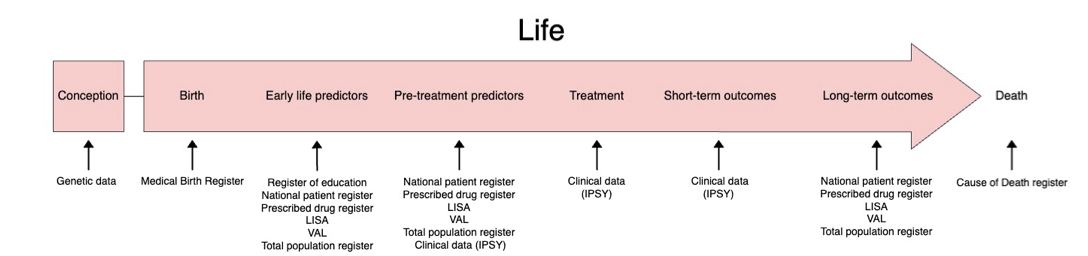
As the title indicates, MULTI-PSYCH is a cohort of patients with anxiety and depression who have been treated with internet-delivered CBT. It is multi modal in the sense that it contains clinical, genetic and nationwide registry data.
MULTI-PSYCH is well positioned for research collaboration. Using MULTI-PSYCH, researchers can improve risk stratification, outcome prediction and secondary preventive interventions. It provides a unique infrastructure to study not only predictors or short-term treatment outcomes, but also longer term medical and socioeconomic outcomes in patients treated with ICBT for depression or anxiety.
Data sources
Points about the cohort:
Includes 2668 clinically well-characterised adults with major depressive disorder, social anxiety disorder or panic disorder.
The patients are assessed before, during and after 12 weeks of ICBT.
All patients have been blood sampled and genotyped.
Clinical and genetic data is to several Swedish registers containing a wide range of variables from patient birth up to 10 years after the end of ICB. These variables include:





 Rücklab - Psychiatry research at Karolinska Institutet