Leoni’s ISP seminar

New PhD students are thriving at Rücklab right now! Today Leoni had her individual study plan (ISP) seminar, presenting her upcoming doctoral studies.

Leoni’s doctoral project goes under the title “Predictive modeling of suicide risk and risk factors using registry and genetic data” and is all about suicide prediction using new technologies and unique multimodal data.

A challenge in the current research field of suicide prevention is that it is hard to study such rare events. To date, the focus has been on suicidal thoughts or attempts rather than actual deaths, and there are reasons to believe that these events differ in terms of prediction. When it comes to compulsory care, we know little about how the current interventions does in the long run, and there is a need for improved suicide prediction tools that can be implemented in a clinical context. 

Leoni will work with the projects 1) Suicide and compulsory mental care and 2) Saving Lives.

  • The first project will be about risk factors for suicide among psychiatric patients under compulsory mental care and will describe and compare suicide risk for these patients, as well as identify risk factors.
  • The second project will be about improving suicide prediction in a total nationwide multimodal suicide cohort. This project aims at discovering genetic and environmental risk factors and also develop predictive models for suicide death.

Leoni’s main supervisor is John Wallert. Co-supervisors are Christian Rück and Ronnie Pingel.

Olly’s ISP seminar

Today, Olly held her individual study plan (ISP) seminar for her doctoral studies. The overall purpose of the studies is to enhance the prediction of health and socioeconomic outcomes in patients with common psychiatric disorders, such as depression and anxiety.

We know that 25-50% of patients with depression and anxiety disorders don’t respond to CBT. These patients may benefit from alternative or tailored treatment formats. We want to explore ways to help them, but in order to do that we need to predict who they are. Existing predictive models of treatment outcome are usually based on clinical data with a small set of predictors which results in low predictive power and limited clinical utility.

Olly’s PhD project will use a big sample from Psykiatri Sydväst’s Internet Psychiatry and predict treatment outcomes for multiple disorders. It will use clinical, genetic and register data to predict both treatment response and long-term socioeconomic disadvantage such as labour market marginalization.

The work consists of four studies.

  • Study 1: Clinical, socioeconomic and genetic predictors of treatment outcomes in internet-delivered cognitive behavioral therapy for depression and anxiety disorders
  • Study 2: Development of a machine learning model to predict response to ICBT treatment at the individual subject level
  • Study 3: Development of a machine learning model aimed at predicting labour market marginalization
  • Study 4: Validation of the model from study 2 in clinical practice

Olly’s main supervisor is Christian, and her co-supervisor is John.

We look forward to this!

The association between depression and anxiety and myocardial infarction

In a freshly published article, Oskar et al. have delved into the connection between depression, anxiety and myocardial infarction (MI).

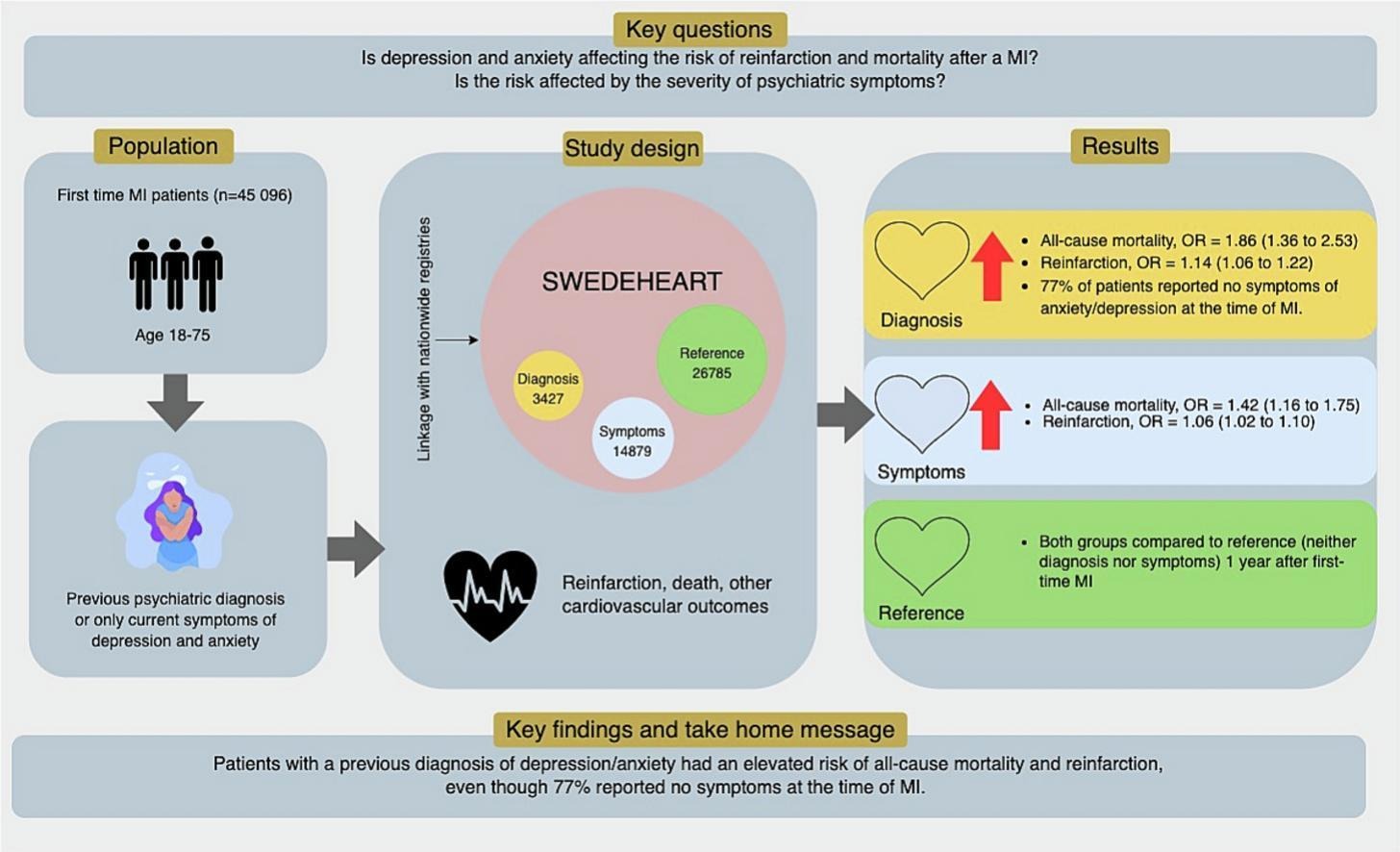
Linking demographic, socioeconomic and clinical data from four nationwide Swedish registries, they found that both a previous diagnosis, and present self-reported symptoms of anxiety or depression are associated with an increased risk of death and recurrent cardiovascular events in adults with first-time MI.

Patients with a diagnosis had a higher risk for MI, even though 77% reported no symptoms at the time of MI. That is, only screening for present symptoms is inadequate for assessing this excessive risk. Assessment of both psychiatric history and self-reported symptoms seems warranted for these patients.

Read the article here.

Graphical abstract

Welcoming Leoni Grossman!

We are happy to welcome another addition to the research group: 🥁🥁🥁 Leoni Grossman!

Leoni is a PhD student in John Wallert‘s team. She has a Masters in Biomedicine with a minor Neuroinformatics and another masters in Applied Computational Life Sciences.

The main scientific objective of Leoni’s PhD is to advance our knowledge in suicide prediction. Her is focused on statistical modelling in two different projects:

  1. Suicide and compulsory care – A registry study of risk factors for suicide among psychiatric patients under compulsive mental care.
  2. Project Saving Lives – Aiming to derive and validate better risk models for suicide in a nationwide suicide cohort using multimodal data.

🎺

Max’s ISP seminar

Today, Max Sannemalm – now a PhD student 🎉 – held his individual study plan (ISP) seminar. The ISP seminar is an opportunity to get input and feedback before starting the projects. Marianne Kristiansson and Joar Guterstam participated from the advisory board and Nitya Jayaram-Lindström participated as an adjunct member.

At the seminar, Max presented the four studies which forms his doctoral studies:

He will be conducting the B4DT study, a non-inferiority study comparing the Bergen 4-day treatment for OCD to conventional CBT for OCD. Along with the RCT, he will do a cost-effectiveness analysis and a qualitative analysis about B4DT and its implementation. In addition, the plan is to do a pilot trial of an ultra-intensive treatment for patients with body dysmorphic disorder (BDD).

Looking forward to seeing Max working wonders!

In Dagens Nyheter, Hanne Kjöller cites Elin Lindsäter et al.’s scoping review about what we know about exhaustion disorder, in a chronicle about externalizing illness.

Exhaustion disorder is the single most common sick leave diagnosis in Sweden. In other countries it does not even exist.

The disorder was introduced into the Swedish version of ICD-10 in 2005, and still exists only in Sweden. The development of the diagnosis has been criticized by members of the Rück research group, mainly because it lacks the scientific basis that usually is required for a diagnosis to take form.

Since the introduction of the diagnosis, the use of it has increased rapidly. It is today almost as prevalent as depression and currently accounts for more long-term sick-leave reimbursement than any other single diagnosis in the country. Ultimately, both patients and tax payers suffer from our lack of knowledge about the condition.

Click here for the scoping review on exhaustion disorder.

Hiring: Research assistant

Are you interested in psychiatric research? We are hiring another research assistant to join the Rück research group!

The employment includes supporting the Saving Lives project and Elin Lindsäter‘s projects about stress and exhaustion.

Work tasks include coordinating projects and have contact with researchers and collaboration partners. You will work with following up on research grants, planning meetings and media activities.

You will be part of a stimulating and educational work environment at the Karolinska Institutet, where you will work closely together with dedicated researchers in psychology and psychiatry.

Read more and apply here.

In the media this week

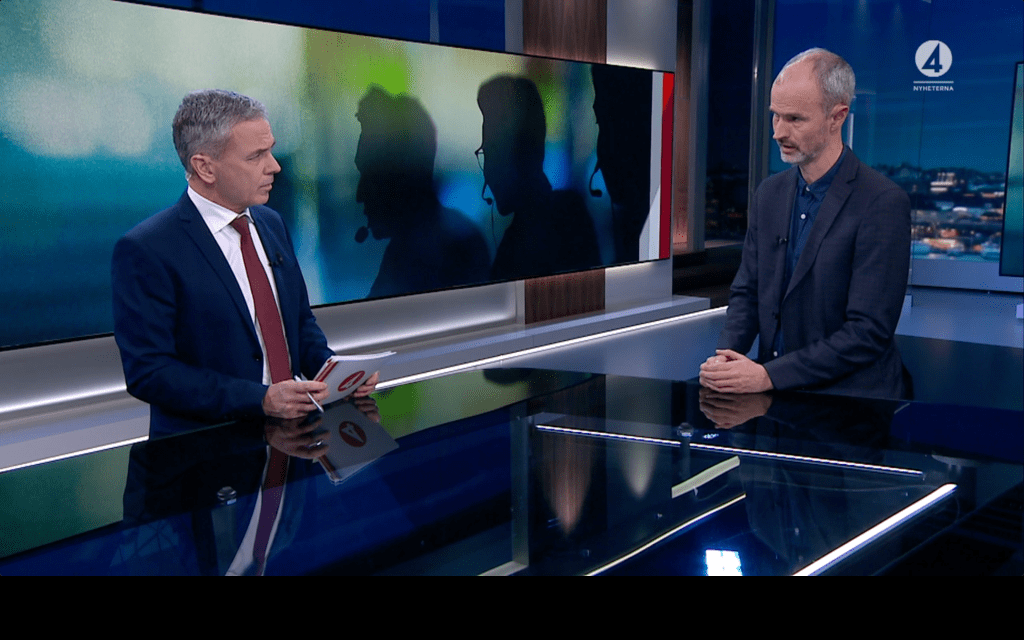
Due to TV4’s feature that a large number of calls do not reach the suicide telephone line, Christian comments on the importance of getting the right help and possible ways to deal with suicide. Watch the clip (in Swedish) here.

Jesper took part in a Dagens Nyheter article about the importance of hair for men, in relation to body dysmorphic disorder and the role hair plays in the identity.

Characterization of exhaustion disorder

As part of the comprehensive approach towards chronic stress, fatigue and exhaustion disorder (ED), Elin et al. have looked into the qualitative aspects of the condition.

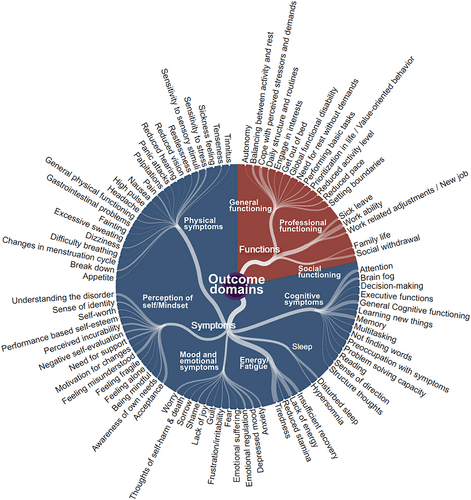
Through an online survey, they interviewed patients diagnosed with ED and healthcare professionals working with these patiens. The aim was to identify outcomes that matter to patients and healthcare professionals.

The study identified various aspects of ED that matter to patiens and clinicians, illustrating the panorama of issues related to the disorder. Hopefully, this is a step to further understand it.

Read the article here.

Illustration of the distribution of categories and subcategories from the qualitative content analysis. 

The research group recently published a review on exhaustion disorder, that indicated that there is limited research on the validity of the diagnosis.