New publication from the statistical modelling team!

The article Predicting remission after internet-delivered psychotherapy in patients with depression using machine learning and multi-modal data is now published in Translational Psychiatry and ready to be read and spread.  

The study applied supervised machine learning with multi-modal data to predict remission of major depressive disorder after internet-delivered psychotherapy. Predictor types were demographic, clinical, process, and genetic and outcome was remission status post ICBT. Transparency analysis showed model usage of all predictor types at both the group and individual patient level. Future iterations of the derived and validated model may inform tailored intervention before initiating ICBT for MDD. The multi-modal approach to predict remission in these patients holds promise and warrants further investigation to establish clinical utility.

The authors are John Wallert, Julia Boberg, Viktor Kaldo, David Mataix-Cols, Oskar Flygare, James Crowley, Matthew Halvorsen, Fehmi Ben Abdesslem, Magnus Boman, Evelyn Andersson, Nils Hentati Isacsson, Ekaterina Ivanova and Christian Rück.

Read the article here.

Internetbehandling mot tvångsmässigt hudplockande (dermatillomani)

Edit: Anmälan är stängd på grund av ett stort antal anmälningar på kort tid/The registration is closed due to a large number of applicants.

Nu drar Rücklab igång rekryteringen till en kontrollerad studie där vi testar effekten av internetförmedlad KBT för dermatillomani jämfört med väntelista. Behandlingen, som är kostnadsfri, pågår under 10 veckor och sker på distans via en säker internetplattform. Kontakt med behandlare sker via textmeddelanden.

Alla som deltar i studien erbjuds behandling. Man måste vara minst 18 år för att delta och boende i Sverige.

Kontakta gärna projektledande psykolog Mia Asplund om du har frågor kring studien! E-post: mia.asplund@ki.se

Vad är dermatillomani?

Dermatillomani eller skin-picking disorder som det kallas på engelska, innebär ett överdrivet plockande, pillande eller klämmande på huden. Ofta plockar man i ansiktet, på armar och händer, men många plockar även hud från andra ställen på kroppen. Det vanligaste är att man söker efter ojämnheter som pormaskar, finnar, hudflikar, förhårdnader, sår eller sårskorpor från tidigare rivande

Hudplockandet kan triggas av ett inre sug, och för vissa leda till en känsla av lättnad eller tillfredställelse. Andras plockande triggas av rastlöshet eller jobbiga känslor som stress och oro och upplever att plockandet hjälper till att lindra dessa negativa känslor.

English translation: The registration is now open for a controlled study testing internet-delivered CBT for dermatillomania (also known as skin-picking disorder). Contact psychologist and project manager Mia Asplund if you have questions about the study. Edit: The registration is now closed.

New article accepted for publication in Translational Psychiatry

A new article just got accepted for publication in the Translational Psychiatry.

Predicting remission after internet-delivered psychotherapy in patients with depression using machine learning and multi-modal data

Authors: John Wallert, Julia Boberg, Viktor Kaldo, David Mataix-Cols, Oskar Flygare, James Crowley, Matthew Halvorsen, Fehmi Ben Abdesslem, Magnus Boman, Evelyn Andersson, Nils Hentati Isacsson, Ekaterina Ivanova and Christian Rück.
Interesting reading ahead!

Introducing Max Sannemalm and the Bergen 4-Day Treatment for OCD

Sunny midsummer was great, but we are even happier that Max Sannemalm just joined our group!

Max is a licensed psychologist and will be joining us as the project coordinator for the randomized controlled non-inferiority trial study comparing the Bergen 4-Day Treatment (B4DT) to gold-standard CBT for OCD.

The Bergen 4-Day Treatment (B4DT) is a new concentrated treatment for OCD developed by Gerd Kvale and Bjarne Hansen from Bergen. In B4DT, patients receive ERP at a clinic during 4 consecutive days. The B4DT has shown to achieve remission in around 70% of patients when delivered in regular care in several uncontrolled treatment trials, and one randomized controlled trial (RCT) including a self-help group and a waitlist group. However, it has yet to be directly compared to gold-standard CBT.

The study will test the non-inferiority, speed of recovery, and cost-effectiveness of B4DT, compared to gold-standard.

To summarize: Exciting things ahead, and welcome to the group, Max!

Two new research assistants needed

Interested in psychiatry research? Want to join the group? We are hiring not one but TWO new research assistants!

The group is certainly expanding. Team leader John Wallert just advanced to Assistant Professor within the group, congratulations! 🎯

We are also hiring two new research assistants for two slightly different employments.

One is for The Joining Forces RCT crew, working with Volen Ivanov and Sofia Jägholm. In this job you will do different tasks related to their RCT on a new combination treatment for hoarding disorder, including screening interviews and home visits with hoarding patients, interviews with housing supporters and managers in the social services and monitoring of data collection as well contact with the project’s various collaboration partners. Read more and apply here. Last day to apply is July 31.

The other one is for John Wallert’s interdisciplinary modeling team, an employment in a project in precision psychiatry. This employment includes assisting John and three others with tasks such as database work, archiving of completed projects, meeting documentation and planning, create and then support a structure for work in the steering group for one of our larger projects and write research information texts. Read more and apply here. Last day to apply is July 31.

Oskar Flygare dissertation

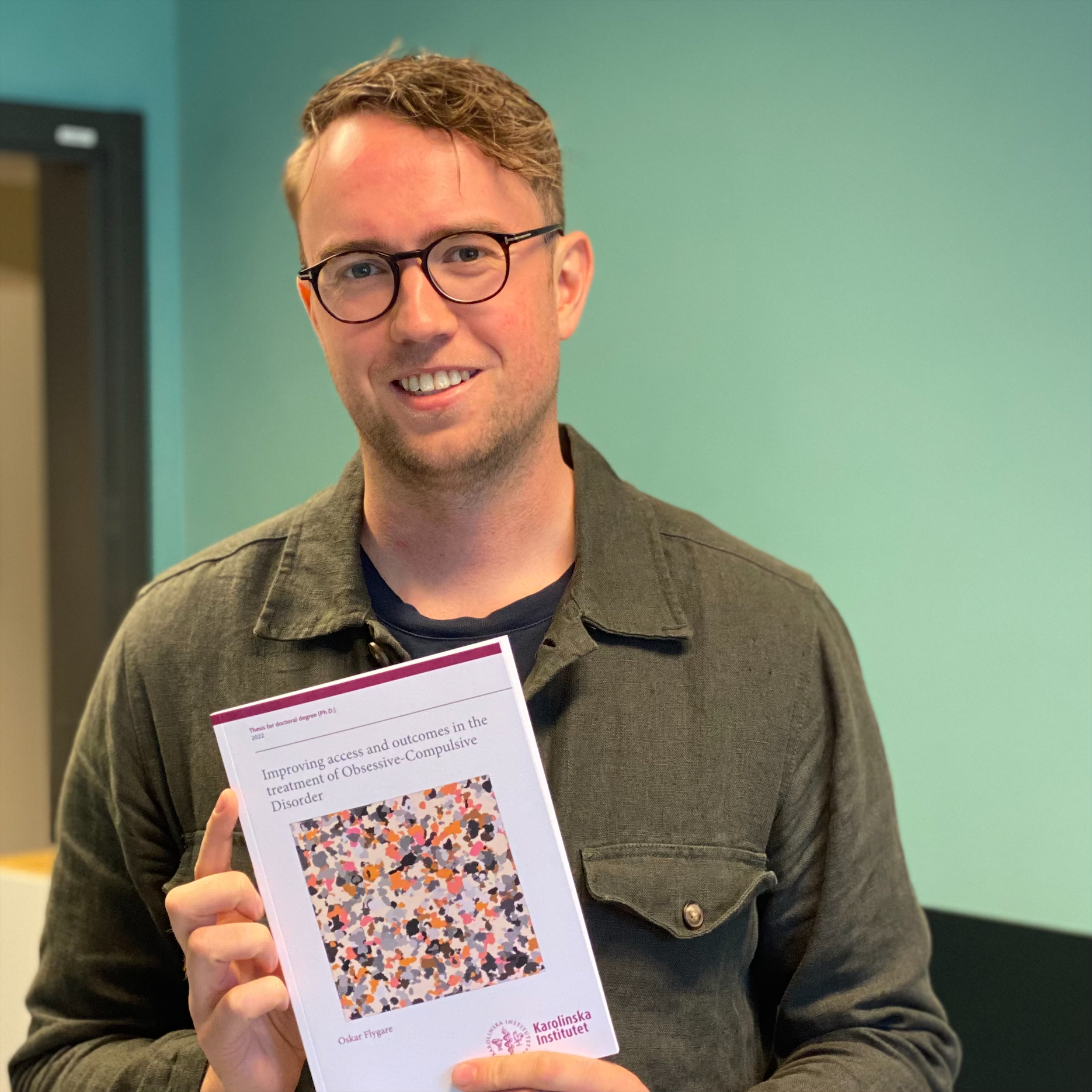
Big day today! Oskar Flygare received his PhD after successfully defending his thesis. Congratulations!

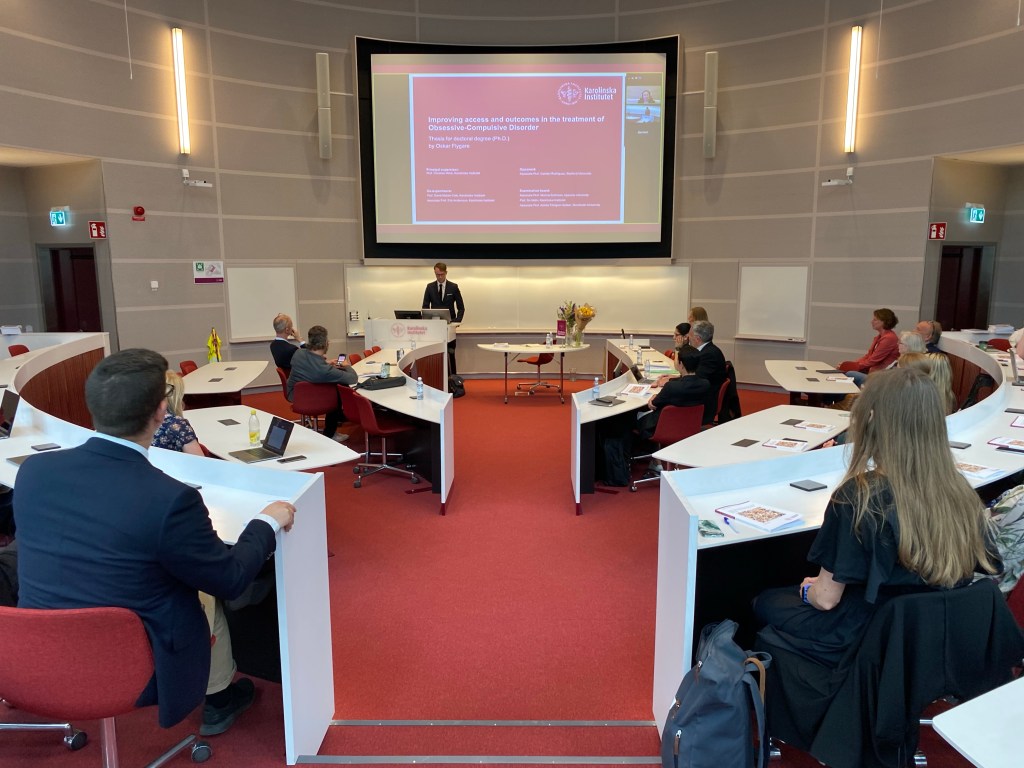
Oskar defended his dissertation “Improving access and outcomes in the treatment of Obsessive-Compulsive Disorder”, today June 10th 9am at the Erna Möller hall at Karolinska Institutet, Huddinge.

The opponent was the excellent associate prof. Carolyn Rodriguez from Stanford University who participated via video link. Oskar was accompanied by supervisor prof. Christian Rück and co-supervisor associate prof. Erik Andersson. Co-supervisor prof. David Mataix-Cols participated via video link. The examination board consisted of associate prof. Monica Buhrman, prof. Bo Melin and associate prof. Armita Golkar.

The Rüch lab is certain that there is yet much to come from the brilliant mind of doctor Oskar Flygare!

Sofia Jägholm talks about hoarding on TV4 Nyhetsmorgon

Sofia Jägholm participated in TV4 Nyhetsmorgon, Swedish morning news and talk show, and talked about the on-going recruitment to the Joining Forces randomized controlled trial.

The study aims to determine the clinical efficacy of in-home decluttering (delivered by a team from a social service unit) augmentation of group CBT for reducing hoarding severity in adults with hoarding disorder. 

Participants will receive protocol-driven group CBT for HD for 12 weeks. After group CBT, participants are immediately randomized to one of two trial arms. In the experimental arm, participants receive 10 weeks of in-home decluttering. In the waitlist arm, participants receive no intervention but fill out questionnaires with identical procedures as in the intervention group. 

Hoarding disorder is a mental disorder on the OCD-spectrum. It is characterized by significant difficulties of discarding or parting with possessions and strong urges to save and often also strong desires to acquire items. Together, these symptoms result in the accumulation of large amounts of items that are kept in a disorganized manner at home, to the degree that normal use of the space is difficult, causing significant impairment in function. 

Click here to watch the clip online at tv4play (in Swedish).

Är du intresserad av att delta i studien och bor i Stockholms kommun? Läs vidare och anmäl intresse här.

Maria Bragesjö new grant and expert in Red Cross committee

Maria Bragesjö has been appointed one of the experts in the Red Cross University advisory committee, a committee with the mission to contribute with external monitoring, expertis and a critical eye at the Red Cross research projects.

She also just received 350 000 kr from Region Stockholm Innovation fund for the development of an internet-delivered CBT treatment for PTSD.

About the project
The overall purpose is to increase accessibility to evidence based treatment for PTSD. The current project is a pilot study is planned to contain n=35 to evaluate the feasibility, acceptability, safety and preliminary treatment effects of the intervention.

There is prejudice that internet-mediated treatment would not be possible to give traumatized individuals, but there is research that it is a safe and effective way to give treatment. In earlier research, Maria and others have shown that this type of intervention is effective and acceptable for newly traumatized patients. In the current study, this intervention has developed to fit patients with PTSD.

If the treatment proves to be effective and acceptable, it would increase the health care’s ability to offer evidence treatment to a large group of patients that today are missing out.

Photo: Micke Sandström

Maria is a Lic. psychologist, PhD, Lic. psychotherapist and a Specialist in clinical psychology. Her research focuses on trauma and PTSD, specifically on early interventions for potentially traumatic events and different ways to effectively treat PTSD and complex PTSD.

Review and debate on exhaustion disorder

Recently, a number of members of the research group together with colleagues from the Stress Research Institute at Stockholm University, published a scoping review on exhaustion disorder where they gathered all empirical studies of exhaustion disorder. The review showed that the existing state of knowledge is scarce and the authors concluded that more research is needed to build a solid knowledge base for exhaustion disorder.

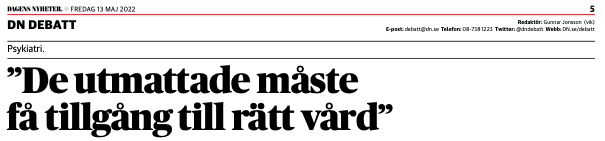
Today, May 13th, the authors also debated the subject in Dagens Nyheter “The exhausted must have access to the right care” (in Swedish), highlighting the fact that new criteria are being developed without first being scientifically evaluated, arguing that there is a great risk for unsafe care and unneccesary suffering for the patients.

The authors are Elin Lindsäter, Frank Svärdman, John Wallert, Ekaterina Ivanova, Anna Söderholm, Robin Fondberg, Gustav Nilsonne, Simon Cervenka, Mats Lekander and Christian Rück. They are affiliated to Karolinska Institutet, Stress Research Institute at Stockholm University and the new in-formal research network Stockholm Stress Collaborative.

Click here for the review Exhaustion Disorder: A Scoping Review of Research on a Recently Introduced Stress.

Click here for the debate article.